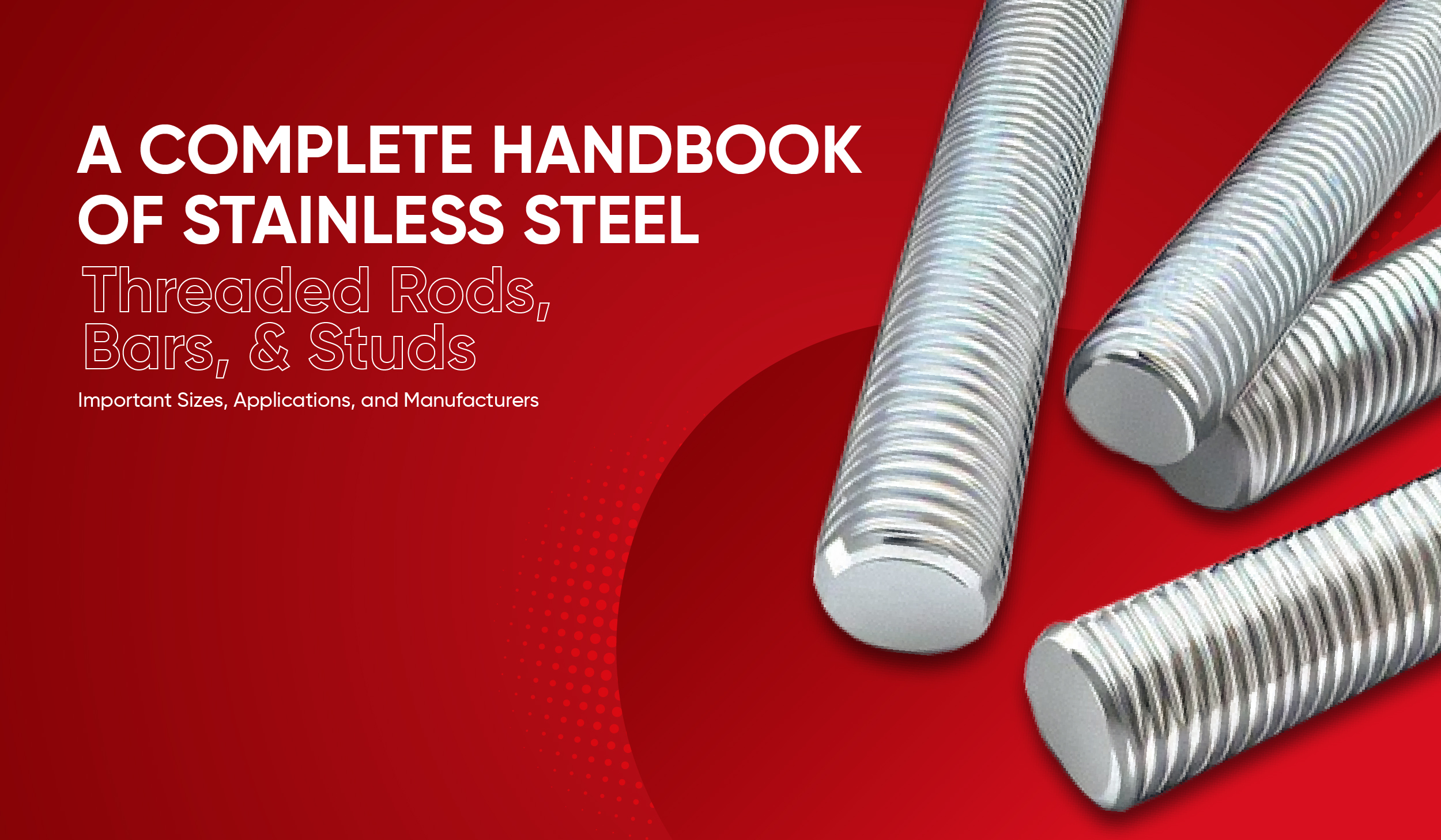
A stainless steel threaded rod is a straight bar with helical threads cut or rolled along part or all of its length, used to anchor or join components in construction, manufacturing, marine and MEP work. This guide covers every decision a buyer needs to make: rod versus stud, grade selection (304, 316, duplex), thread standards, sizing and what to look for in a manufacturer.
Quick summary
- Threaded rods are fully threaded and cut to length on site. Studs are shorter, threaded only at both ends, and used to bolt flanges or equipment.
- Use 304 (A2) for general indoor and dry outdoor work. Switch to 316 (A4) near saltwater, coastal air, or chemical splash zones.
- Metric sizes (M6 through M45) follow ISO standards. Inch sizes (1/4″ through 1″) follow UNC or UNF per ASME B1.1.
- The most commonly ordered sizes are M8, M10, M12, M16, M20, and M24 in metric, and 3/8″, 1/2″, 5/8″, 3/4″, and 1″ in inch.
- Apply anti-seize compound to stainless threads before assembly. Galling can seize a nut onto a bolt in seconds.
What are stainless threaded rods, bars and studs?
A threaded rod is a length of round bar with a continuous helical thread along its surface.
A stud is a shorter fastener, threaded on both ends with an unthreaded shank in the middle, designed to bolt two components together under controlled preload.
Stainless steel is the preferred material because its chromium content (minimum 10.5%) forms a passive oxide layer that resists rust, pitting and crevice corrosion without any coating.
These products appear in anchor bolts in concrete foundations, hanger rods suspending HVAC ductwork, flange studs in chemical piping, tie rods in marine railings and assembly fasteners in food processing equipment.
Threaded rod vs threaded bar vs stud: differences that matter
Threaded rod (fully threaded)
A fully threaded rod has threads running end to end, ships in standard lengths (1 m, 2 m, 3 m, or 6 m), and gets cut on site. Because a nut can sit anywhere along the rod, it is the go-to product for suspended supports, through-bolting, and adjustable assemblies.
Stud (double-end, tap-end, stud bolt)
A stud bolt has threads at both ends separated by a plain shank. One end screws into a tapped hole, and a nut tightens onto the other. Studs are standard in pressure vessel flanges and heavy equipment. ASTM A193 Grade B8 (304) and B8M (316) are the most frequently specified stud bolt grades.
“Threaded bar” terminology
In India, the UK, and parts of Europe, “threaded bar” and “threaded rod” mean the same product. In North America, “threaded rod” or “all-thread” is the standard trade name.
Comparison across these products: rods are fully threaded and pair with two nuts and washers for through-bolting; studs are threaded at both ends and use one tapped hole and one nut; and rods pair with hex nuts, coupling nuts, flat washers, and spring washers, while studs use heavy hex nuts and hardened washers per ASTM A194.
Stainless grades for threaded products: 304 vs 316 vs duplex
304 / A2 (general purpose)
Grade 304, also called A2 or “18-8” (roughly 18% chromium, 8% nickel), is the default stainless steel for threaded rods. It handles indoor environments, mild outdoor exposure, and freshwater contact. It is the most widely stocked grade, which means shorter lead times and lower cost.
Use 304 when the installation is indoors, sheltered from rain, or located well away from any coastline.
316 / A4 (marine, coastal, chemical splash)
Grade 316 adds 2-3% molybdenum to the 304 base chemistry. That addition makes a large difference in chloride resistance. Where 304 develops pitting within months in a coastal environment, 316 can last years. The cost premium over 304 is typically 15-25%, but it pays for itself by avoiding early replacement.
Common mistake: Specifying 304 in a coastal or salt-spray environment because it is cheaper. Within a year or two, brown rust stains appear on the threads, and the rods need replacement. The total cost, including labour and downtime, far exceeds the material savings.
Thread Standards And Thread Types: What Buyers Ask For
Metric: M sizes and coarse vs fine pitch
Metric threads are designated by “M” followed by the diameter in millimetres. An M12 rod has a 12 mm major diameter with a standard coarse pitch of 1.75 mm, while an M12 fine has 1.25 mm pitch.
Coarse threads are faster to assemble, more tolerant of minor damage, and less prone to cross-threading. Fine threads hold better against vibration and allow finer adjustment. For most construction and general industrial work, coarse pitch is the right choice.
Inch: UNC and UNF (where used)
UNC (Unified National Coarse) and UNF (Unified National Fine) follow ASME B1.1 and are standard in North America and in oil and gas projects worldwide. A 1/2″-13 UNC rod has a half-inch diameter with 13 threads per inch. UNC is the workhorse for structural work. UNF appears in aerospace, automotive, and pressure equipment.
Fit and class: what it means in practice
Class 2A/2B is standard for almost all commercial threaded rods and nuts, giving a good balance between easy assembly and minimal play. When sending an RFQ, always specify: size, pitch, standard, length, grade, and class. Incomplete specifications cause delays and re-orders.
Sizes And Selection: Diameter, Pitch, Length, Engagement
Diameter
Diameter is driven by the load the rod needs to carry. For lighter duty (cable trays, lightweight ductwork), M8 or M10 is common. Medium structural work uses M16 to M24. Heavy flanged connections may require M30 and above.
Pitch
Default to coarse pitch unless you have a specific engineering reason for fine. Coarse is easier to source, less sensitive to thread damage, and assembles faster.
Length and thread engagement
Standard stocked lengths are 1 m, 2 m, 3 m, and 6 m. When calculating rod length, account for the clamped material thickness, plus a flat washer on each side, plus a nut height on each side, plus 2-3 exposed threads beyond each nut for visual confirmation of full engagement. A practical minimum engagement rule: nut height of at least 1x the rod diameter for steel-to-steel, or 1.5-2x for softer materials like aluminium.
Performance Essentials: Strength, Corrosion, And Galling
Strength basics: tensile and proof load
For A2-70 (304), the minimum ultimate tensile strength is 700 MPa and proof stress is approximately 450 MPa. For A4-80 (316), ultimate tensile is 800 MPa and proof stress is around 600 MPa, per ISO 3506-1. Design to proof load, not ultimate. Under-tightened studs loosen under vibration; over-tightened studs risk thread stripping.
Corrosion risks for threads
Threads create crevices that trap moisture, making threaded connections more vulnerable to pitting than plain bar of the same grade. In chloride-bearing environments, 304 threads corrode faster than 304 plain bar because the thread roots hold chloride-rich moisture. This is another reason to specify 316 or duplex wherever chlorides are present.
Galling: what it is and how to prevent it
Galling is cold welding that happens when stainless threads seize during tightening. The protective oxide film gets scraped off under pressure, exposing bare metal. Friction generates heat, and the surfaces fuse. Once it starts, the fastener must be cut off.
Prevention steps:
- Apply anti-seize lubricant (molybdenum disulfide, graphite, or PTFE-based) to the threads before assembly.
- Tighten slowly. Avoid high-speed power tools with stainless fasteners.
- Pair dissimilar alloys where possible, for example a 304 nut on a 316 rod.
- Inspect threads for nicks, dents or dirt before assembly.
Applications By Industry With Examples
Construction and infrastructure
Threaded rods anchor steel frames and suspend ceilings. Grade 304 is standard for interior work. For exterior facades and bridges with road salt exposure, specify 316.
HVAC and MEP supports
Threaded rod is the standard hanger for ductwork, piping, and cable trays. M10 or M12 rods (3/8″ or 1/2″) in 1-3 m lengths are typical. Use 304 indoors; use 316 in swimming pool buildings, food processing plants, and hospital clean rooms.
Marine and coastal
Coastal and offshore work demands 316 at minimum. For subsea or splash-zone work on offshore platforms, duplex 2205 is often specified for its higher strength and pitting resistance in warm seawater.
Oil and gas, chemical and fabrication
Stud bolts per ASTM A193 Grade B8M (316) are standard in refinery flange connections. Chemical plants use 316L (low carbon) for welded assemblies. Fabrication shops use threaded rod for jigs, fixtures, and adjustable workholding.
Quality And Manufacturing: What To Check Before You Buy
Thread rolling vs thread cutting
Thread rolling displaces material rather than removing it. The grain flow follows the thread contour, producing a stronger and smoother surface than cut threads. Rolled threads also have better fatigue resistance. Most quality manufacturers, including Laxcon Steels, use thread rolling for their stainless threaded bars.
QC checklist
Before accepting a shipment, confirm: thread gauging with GO/NO-GO ring gauges per the applicable standard; grade verification by PMI (Positive Material Identification) using a handheld XRF analyser for critical applications.
Also, surface inspection for cracks, seams, tool marks and marking with grade, size, heat number and manufacturer ID. A Mill Test Certificate (MTC) per EN 10204 Type 3.1 should accompany every shipment.
Manufacturers And Suppliers: How To Choose The Right One
Manufacturer vs trader or stockist
A manufacturer melts the steel, rolls the bar, and forms the threads in-house. A trader buys finished rods from various sources and resells them. The difference matters for traceability and consistency. When a quality issue arises, a manufacturer can trace the rod back to the specific melt.
Supplier evaluation checklist
Evaluate based on: manufacturing capability (in-house melting gives better chemistry control), grade range (304, 316, 316L, duplex), size range, documentation (MTC per EN 10204 3.1, NABL test reports, heat traceability), lead time, export packing (HDPE/LDPE wrap, ISPM-15 cases), and batch-to-batch consistency.
Laxcon Steels Limited, with over 45 years of steelmaking experience and 1,40,000 metric tonnes annual capacity, produces threaded bars from M6 to M45 in A2 and A4 grades.
The company holds ISO 9001, AS 9100, IATF, Lloyd’s Register, DNV and ABS approvals. For a quote, contact [email protected].
Conclusion
Choosing the right stainless steel threaded rod comes down to four decisions: grade, size, thread standard, and supplier quality. Match the grade to the environment, the size to the load, and verify that the manufacturer provides full traceability.
For enquiries on stainless steel threaded bars, contact Laxcon Steels or email [email protected].