Stainless Steel: Composition and Manufacturing Process
Send an enquiryStainless steel is a family of iron-based alloys defined by a chromium content of roughly 10.5 percent or more. At that level, chromium at the surface reacts with oxygen faster than the iron does and forms a chromium oxide layer a few nanometres thick. The layer is transparent, tightly bonded and self-repairing: when the surface is scratched, machined or cut, the film reforms as soon as air or water reaches the fresh metal. Rust on ordinary steel is porous and flakes away, exposing more iron; the oxide on stainless steel is dense and remains in place. Stainless steel therefore corrodes, but the corrosion forms a stable film at the surface and then stops.
Composition
A small set of alloying elements accounts for the properties of every stainless grade. The grade register maintained by Laxcon carries 547 grades, of which 167 are stainless, and the composition windows below are taken from it.
| Element | What it does | Where it sits in the register |
|---|---|---|
| Chromium | Forms the passive oxide film. The defining element | 11.5 to 13.5 percent in 410, 18.0 to 20.0 in 304, up to 30.0 in S 44735 |
| Nickel | Stabilises the austenite phase: ductility, formability, low-temperature toughness | not specified in most ferritic grades, 8.0 to 10.5 in 304, up to 38.0 in Alloy 20 |
| Carbon | Strength and hardenability, at the cost of weldability and corrosion in the heat-affected zone | 0.03 percent maximum in the L grades, up to 1.20 percent in 440 C, the highest in the register |
| Molybdenum | Repairs the passive film where chloride has broken through. The reason 316 costs more than 304 | not specified at all in 102 of the 167 stainless grades, up to 8.0 percent in 654 SMO |
| Nitrogen | Strength, and pitting resistance. Substitutes for some of the nickel | not specified in 106 of the 167, and merely tolerated rather than required in many of the rest. Up to 0.55 percent in 654 SMO |
| Manganese | Deoxidation, and an austenite stabiliser standing in for nickel in the 200 series | 2.0 percent maximum in most, 7.5 to 10.0 in 202 |
| Titanium and niobium | Tie up carbon as a stable carbide before chromium can reach it | 321 and 347, and the precipitation hardening grades |
| Copper and aluminium | Form the precipitates that harden the PH grades on ageing | 3.0 to 5.0 percent copper in 17/4 PH |
The five families
Stainless grades are classified into five families by crystal structure. The structure is set by the balance between the elements that stabilise austenite (nickel, manganese, nitrogen, carbon) and those that stabilise ferrite (chromium, molybdenum, silicon). The counts below are the counts in the register.
| Family | Grades in the register | Structure | Chosen for |
|---|---|---|---|
| Austenitic | 71 | Face centred cubic, non-magnetic when annealed | Corrosion resistance, formability, weldability. The 300 and 200 series |
| Martensitic | 46 | Hardenable by quenching, magnetic | Hardness, wear, cutting edges, shafts. The 400 series high-carbon grades |
| Ferritic | 26 | Body centred cubic, magnetic, not hardenable by quench | Cost, and stress corrosion cracking resistance, at low nickel |
| Duplex | 15 | Roughly half ferrite, half austenite | Double the proof stress with better chloride resistance |
| Precipitation hardening | 9 | Martensitic, semi-austenitic or austenitic matrix, aged | High strength in a finished machined part with little distortion |
The remaining 380 grades in the register are alloy steels, carbon steels, tool steels, nickel alloys, titanium and spring steel. Laxcon melts these on the same plant, which is why the register is not limited to stainless grades.
The manufacturing route
The stages below describe the production route operated by Laxcon. The equipment and capacities are published on the technology page.
1. Melting
The charge is scrap. Electric melting furnaces bring it to liquid, with a vibro feeder adding lime, dolomite and ferro alloys and a top lancing facility supplying oxygen. Annual melting capacity is 140,000 metric tonnes. The electric route requires neither iron ore nor a blast furnace, and it is the reason stainless steel is among the most recycled industrial materials.
Incoming scrap is screened for radioactive contamination with a Rad Eye meter before it reaches the furnace. This control is the basis of the freedom-from-contamination declaration carried on a certificate.
2. Refining
Refining addresses the central chemical problem of stainless production: chromium and carbon both oxidise readily, and the carbon must be removed without removing the chromium.
- An AOD converter with an automatic gas mixing station performs argon oxygen decarburisation. Diluting the oxygen with argon lowers the partial pressure of carbon monoxide, so carbon burns out preferentially and the chromium stays in the bath. Without this step, low-carbon stainless would be prohibitively expensive.
- A ladle refining furnace holds temperature and finishes the chemistry.
- Vacuum degassing and vacuum oxygen decarburisation remove dissolved hydrogen, oxygen and nitrogen, which, with the inclusion control that follows, is what internal cleanliness means in practice.
- Electro slag refining is available where the application demands the cleanest possible structure.
- Cored wire injection of titanium, sulphur and calcium silicide makes the final adjustments.
Every heat is sampled from the ladle during pouring and analysed on optical emission spectrometers before it is cast. That analysis is the one reported on the test certificate.
3. Casting
Two routes leave the melt shop. A twin-strand continuous caster of 9/16 metre radius, PLC operated with an electromagnetic mould stirrer, produces billets and blooms in square sections from 120 to 300 mm, rectangles to 300 by 160 mm and rounds from 200 to 300 mm. Bottom poured ingot casting produces ingots from 655 kg up to 20,000 kg per piece, in square, fluted and round moulds.
4. Hot rolling
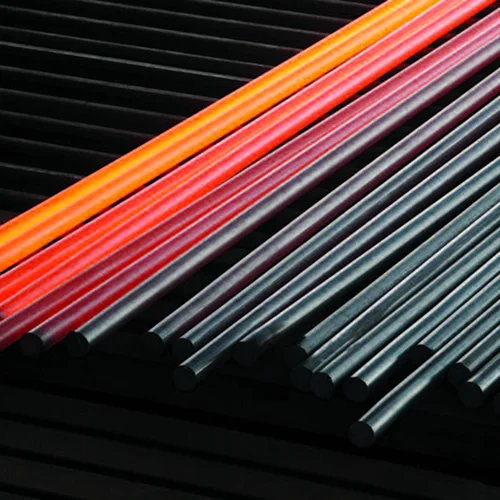
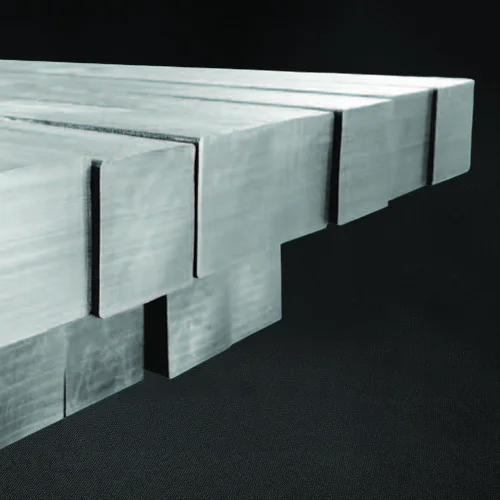
Four semi-automatic cross-country mills, with 21 stands in total, run at 20, 16, 14 and 12 inch sizes. Billets are reheated in an automatic pusher-type furnace and rolled to section, with online hot saw cutting. This stage converts a bloom into a round bar, an angle, a channel or a flat.
5. Heat treatment
Six PLC controlled furnaces handle bars up to 7 metres: two electrical tempering furnaces at 10 and 18 tonnes, a gas fired soft annealing furnace at 40 tonnes, and three gas fired solution annealing furnaces at 6 tonnes each. A 60 kilolitre water quench tank serves solution annealing and a 50 kilolitre oil tank serves hardening, with quench delay held under one minute.
The quench delay is the critical figure for austenitic and duplex grades. Solution annealing dissolves the carbides back into the matrix, and the quench prevents them from reforming during cooling. A slow quench reverses the effect of the anneal.
6. Pickling and cold finishing
Hot rolled sections leave the mill covered in scale, which is not the passive film. Pickling in acid removes the scale and leaves clean metal that can repassivate. This is the P in HRAP, and it is why the finish is specified on structural sections.
Fifteen bar processing and finishing lines then produce the cold finished range: automatic peeling, polishing, centreless grinding, wire drawing, draw benches, straightening, chamfering, grit polishing, shot blasting, thread rolling and eddy current inspection. These lines convert a black bar into a bright bar at h7 to h11 tolerance and Ra 0.2 micron, or a precision shaft quality bar at 0.015 inch TIR per 10 feet.
7. Testing and packing
Testing runs in a NABL accredited laboratory at Sanand, Ahmedabad, assessed to ISO/IEC 17025:2017: wet chemistry, mechanical testing, automatic impact testing, metallography with image analysis, a Leco gas analyser for hydrogen, oxygen and nitrogen, and handheld spectrometers for grade confirmation on the piece. Bundles run 500 to 1,000 kg with HDPE or LDPE wrapping and two lifting slings, or ISPM 15 wooden boxes for export, each marked with heat number, grade, size, and net and gross weight.
Recycling
The charge is 100 percent scrap, melted with electricity, which removes the blast furnace and basic oxygen furnace route that accounts for most of the steel industry's emissions. A wind and solar hybrid power project of 25 MW capacity supplies into the operation. The published greenhouse gas emission intensity is 1.37 MTCO2e per tonne of production; the scope one, two and three breakdown behind that figure, with its verification, is on the sustainability page. Stainless steel does not degrade on recycling in the way many materials do, because the alloying elements are recovered along with the iron and adjusted back to specification in the ladle.
Frequently asked questions
What makes steel stainless?
Chromium, at roughly 10.5 percent and above, forms a self-repairing chromium oxide film on the surface. No other element produces the effect, and no surface treatment substitutes for it, because the film reforms from within the metal when the surface is damaged.
Does stainless steel rust?
Stainless steel can rust when the passive film is prevented from reforming or is locally destroyed. The three usual causes are chlorides pitting through the film, embedded iron particles from carbon steel tooling rusting on the surface, and crevices where oxygen cannot reach. The film needs oxygen to exist, so a gasket face or an unwashed crevice is more vulnerable than an exposed surface.
Is stainless steel an alloy?
Stainless steel is an alloy of iron with chromium as the defining addition, plus nickel, molybdenum, carbon, manganese, nitrogen, silicon and, in some families, titanium, niobium, copper or aluminium.
How much of stainless steel is recycled material?
Laxcon's charge is 100 percent scrap. The electric arc route used for stainless long products worldwide is built around scrap rather than ore, and the alloying elements are recovered with it.
What is the difference between hot rolled and cold finished?
Hot rolling shapes the section above the recrystallisation temperature and leaves a black scaled surface at open tolerances. Cold finishing draws, peels, grinds or polishes at room temperature and provides dimensional accuracy and surface quality. On Laxcon's range the difference is 16 to 125 mm hot rolled round bar at ASTM A484 tolerances, against 5 to 115 mm bright bar at h7 through h11 with Ra 0.2 micron.
What does HRAP mean?
HRAP means hot rolled, annealed and pickled. The section is rolled hot, solution annealed to restore the structure and the corrosion resistance, and then acid pickled to strip the mill scale. It is the standard supply condition for Laxcon's angles, flats, channels and T sections.
Sources
Furnace, converter, caster, mill, heat treatment, finishing and packaging equipment and capacities are published on the technology page. Laboratory accreditation and inspection instruments are on the quality page. Grade counts by family and every composition window are in the grade reference, which carries 547 grades. Size ranges, tolerances and supply conditions are on the individual product pages. The emissions intensity figure and its verification are on the sustainability page.