Ingot, Bloom, Billet and Slab: The Semi-Finished Forms of Steel
Send an enquiryIngots, blooms, billets and slabs are the semi-finished forms of steel: solid pieces cast from liquid steel and sold or rolled onward rather than used as they are. An ingot is cast into a mould and is the feedstock for forging or for the first rolling pass. A bloom is a continuously cast or rolled section larger than about 150 mm square, and it is rolled into structural sections and large bar. A billet is the same form at 150 mm square or smaller, and it is rolled into bar, wire rod and seamless tube. A slab is a rectangular section far wider than it is thick, and it is rolled into plate, sheet and strip. The four are distinguished by shape and by size, not by grade: any steel, carbon, alloy or stainless, can exist in all four forms.
The four forms defined
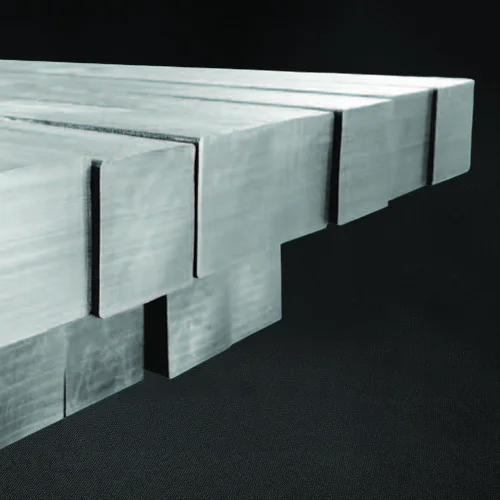
The names follow the cross-section. A billet is square or round, typically 100 to 150 mm across, though the term is used down to 50 mm square and, in some mills, up to 160 mm. A bloom is square or near-square and larger than a billet, from about 150 mm across upwards, with the larger casters running past 400 mm square and round casters past 800 mm in diameter; the boundary between billet and bloom is a convention that varies by mill and by standard, and many caster specifications treat 150 mm square as the dividing size. A slab has a width several times its thickness, commonly 150 to 250 mm thick and 600 to 2,500 mm wide. An ingot takes the shape of its mould, usually a tapered square, octagon or round, and its mass runs from a few hundred kilograms to several tonnes.
| Form | Cross-section | Typical size | Cast by | Becomes |
|---|---|---|---|---|
| Ingot | Tapered square, octagonal or round, set by the mould | 500 kg to several tonnes | Pouring into a static mould | Forgings; blooms and slabs by rolling |
| Bloom | Square or near-square | Over 150 mm across, to 400 mm and beyond on large casters | Continuous casting, or rolling an ingot | Structural sections, rail, large bar, billets |
| Billet | Square or round | 50 to 150 mm across | Continuous casting, or rolling a bloom | Bar, wire rod, seamless tube hollows |
| Slab | Rectangular, width several times thickness | 150 to 250 mm thick, 600 to 2,500 mm wide | Continuous casting, or rolling an ingot | Plate, sheet, strip, coil |
Ingot casting and continuous casting
Until the 1960s all steel was cast as ingots. Liquid steel was teemed from the ladle into cast iron moulds, allowed to solidify, stripped, reheated in soaking pits and rolled on a blooming or slabbing mill into blooms and slabs. Continuous casting replaced this route for most tonnage. The ladle feeds a tundish, the tundish feeds one or more water-cooled copper moulds without a bottom, and the steel leaves each mould as a solid shell around a liquid core, is supported by rolls, sprayed with water until solid through, then cut to length by torch or shear. The strand leaves the machine already shaped as a billet, bloom or slab, so the blooming mill is not needed.
The two routes differ in yield and in internal quality. An ingot solidifies from the outside in and from the bottom up, and the last liquid to freeze, at the top and centre, is enriched in carbon, sulphur and phosphorus and often contains a shrinkage cavity called the pipe. The top of the ingot is cropped and discarded, so the yield of usable steel from an ingot is typically 80 to 88 percent. A continuously cast strand solidifies over a short length under controlled cooling, so segregation is confined to a narrow centreline and there is no pipe; the yield is 95 percent or better. Continuous casting also gives a more uniform grain structure and a consistent section from end to end.
Ingots remain the route for two products. Large forgings, for shafts, rings, discs and pressure parts, need a mass of steel that no caster strand provides, so they start from a forging quality ingot cast for the purpose. Some specialised and small-lot grades are still cast as ingots because a caster sequence cannot be set up economically for a few tonnes. In both cases the segregated top is cropped before forging.
What each form becomes
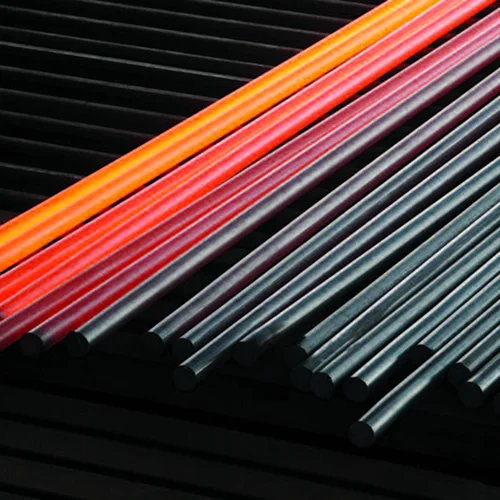
The semi-finished form is chosen for the finished product it will make. A billet is reheated to about 1,150 to 1,250 degrees Celsius and rolled on a bar mill into round, square, hexagonal and flat bar, or on a rod mill into wire rod for drawing; a round billet is also pierced on a cross-roll piercing mill to make the hollow shell for seamless tube. A bloom is rolled on a section mill into beams, channels, angles and rail, or on a large bar mill into round bar too big for a billet mill to roll, or it is rolled down into billets. A slab is rolled on a plate mill or a hot strip mill into plate, hot rolled coil, and, after cold rolling, sheet and strip. An ingot goes to the forge, where hammers or presses work it into open-die forgings, or to a primary mill that converts it to bloom or slab.
The rolling ratio matters for quality. A bar rolled from a billet with a reduction ratio of at least 6 to 1, and preferably higher, has its cast structure fully broken down and its centreline porosity closed. Bar specifications such as ASTM A276 and EN 10088-3 do not state a minimum ratio, but forging and aerospace specifications often do, which is why a large-diameter bar is rolled from a bloom or forged from an ingot rather than cast close to size.
Defects and inspection
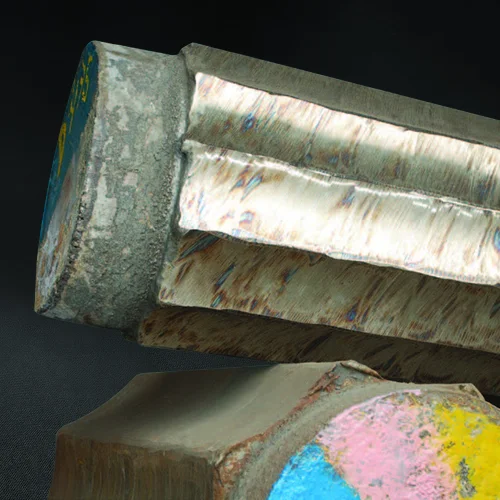
Semi-finished steel passes the defects of casting to the finished product unless they are found and removed. Surface defects are cracks (longitudinal, transverse and corner cracks from mould friction or uneven cooling), oscillation marks from the mould's reciprocation, slag inclusions and scabs. They are removed by grinding, scarfing or peeling, an operation called surface conditioning, before the billet or bloom is reheated. Internal defects are centreline segregation, centre porosity, inclusion clusters and, in ingots, the pipe. They are detected by ultrasonic testing of the strand or bloom, by macro-etching a sawn cross-section in hot acid (the sulphur print and the macro etch of ASTM E381), and by chemical analysis of the centreline against the ladle analysis.
Stainless steel adds requirements of its own. The heat analysis of the ladle sample is checked against the grade's composition window on an optical emission spectrometer, and the product analysis, where the order calls for one, is checked against the same window with the product tolerances that ASTM A484 and EN 10088 allow for bars, billets and forgings. Hot workability tests are run on grades that crack easily during rolling, such as the free-machining and some ferritic grades. The mill test certificate for a billet or bloom therefore states the heat number, the ladle analysis, the product analysis where required, the surface condition, and the test results called for by the order.
How semi-finished steel is ordered
An order for a billet or bloom states the grade and its standard, the section shape and size with its tolerance, the length or the piece weight, the surface condition (as cast, ground, peeled or fully conditioned), the heat treatment condition where one applies, the inspection and testing required, and the type of inspection document under EN 10204. The size tolerance is usually a plus-and-minus figure on the side length, with a limit on rhomboidity (the difference between the two diagonals of a square section) and on straightness. Lengths are cut to suit the customer's reheating furnace and mill, commonly 3 to 12 metres for billets. For forging ingots the order states the mass, the mould shape and the crop allowance, since the forger needs to know how much sound steel is under the segregated top.
Semi-finished steel at Laxcon Steels
Laxcon Steels melts stainless and alloy steel in its own melting shop and casts it on a continuous caster into billets and blooms, which feed its rolling mills and are also sold as semi-finished steel to other mills and forges. It casts forging quality ingots for forging shops that need a mass of steel beyond a caster section. The billets are rolled in the company's own mills into hot rolled round bar from 16 to 125 mm and into the other long products on the technology page. The route from scrap to bar is described in the article on how stainless steel is made.
Frequently asked questions
What is the difference between a billet and a bloom?
Size. Both are square or near-square continuously cast or rolled sections, and the convention in most mills is that a section up to 150 mm across is a billet and a larger one is a bloom. A billet is rolled into bar, wire rod and tube hollows; a bloom is rolled into structural sections, rail and large bar, or rolled down into billets.
What is the difference between an ingot and a billet?
An ingot is cast into a static mould and takes the mould's tapered shape; it is the feedstock for forging or for a primary rolling mill. A billet is cast on a continuous caster, or rolled from a bloom, to a fixed square or round section ready for a bar mill. An ingot has a segregated top that is cropped; a continuously cast billet has no pipe and a yield above 95 percent.
What is a slab used for?
A slab is the semi-finished form for flat products. It is rolled on a plate mill into plate or on a hot strip mill into hot rolled coil, and the coil is then cold rolled into sheet and strip. Slabs are not used for bar, rod or tube, which start from billets.
Why are large forgings made from ingots and not from cast blooms?
Two reasons, and neither is a limit on the size a caster can reach: bloom casters run well past 400 mm square and round casters past 800 mm in diameter. The first reason is the reduction ratio. A forging is judged on how far the cast structure has been worked, and the forge needs a starting section several times the finished one, so a shaft or ring of a metre across starts from a piece larger than any caster section a bar mill holds in stock. The second is the metallurgy the forging calls for. An ingot is cast one piece at a time, can be made in a grade or a size the caster is not set up for, can be poured under vacuum or remelted for cleanliness, and its segregated top is cropped and discarded rather than rolled. A caster is built for volume in a fixed set of sections, which is the opposite requirement.
Sources
- ASTM A276/A276M, Standard Specification for Stainless Steel Bars and Shapes.
- ASTM A484/A484M, General Requirements for Stainless Steel Bars, Billets, and Forgings (product analysis tolerances, surface condition and permitted variations).
- ASTM E381, Standard Method of Macroetch Testing Steel Bars, Billets, Blooms, and Forgings.
- EN 10088-3, Stainless steels, technical delivery conditions for semi-finished products, bars, rods, wire, sections and bright products.
- EN 10204, Metallic products, types of inspection documents.
- The Making, Shaping and Treating of Steel, AIST, casting and primary rolling chapters.