Hot Rolled vs Cold Rolled vs Cold Drawn Steel: What Each Process Changes
Send an enquiryHot rolled steel is steel shaped between rolls at a temperature above its recrystallisation point, about 1,100 to 1,250 degrees Celsius for stainless bar, so that the metal recrystallises as it deforms and leaves the mill soft, scaled and within a wide dimensional allowance. Cold rolled steel is flat product, sheet and strip, rolled again at room temperature after pickling, which gives a smooth surface, a close thickness tolerance and a higher strength from work hardening. Cold drawn steel is bar or wire pulled through a die at room temperature, the equivalent process for long products, and it is sold as bright bar. The three terms therefore describe a temperature and a product form, not a grade: the same 304 or EN8 can be bought in any of the three conditions, and the choice sets the tolerance, the surface, the strength and the price of the material.
The difference in one table
| Property | Hot rolled | Cold rolled | Cold drawn or peeled |
|---|---|---|---|
| Product form | Bar, sections, plate, hot strip, seamless tube | Sheet, strip, coil | Round, hexagon, square and flat bar; wire |
| Working temperature | Above recrystallisation, 1,100 to 1,250 degrees Celsius for stainless | Room temperature | Room temperature |
| Surface | Oxide scale as rolled; matt grey after pickling | Smooth, 2B or bright annealed finish | Scale removed; 0.8 to 1.6 micrometres Ra drawn, 0.2 to 0.4 ground |
| Dimensional tolerance | EN 10060 or ASTM A484 allowance, about plus or minus 0.8 mm on a 50 mm bar | EN 10259 thickness tolerance, hundredths of a millimetre | ISO 286 class h9 to h11 drawn, k12 and k13 peeled, h6 to h8 ground |
| Strength | Annealed values of the grade | Raised by cold reduction unless annealed after rolling | Raised by the draw; annealed values where supplied annealed |
| Straightness | To the rolling standard, typically 4 mm per metre | Flatness to the strip standard | Straightened after finishing, 0.5 mm per metre or better |
| Relative cost | Base | Higher, by the second rolling pass | Higher, by the finishing pass and the material removed |
| Typical use | Parts machined all over, structural sections, forging stock | Panels, pressings, appliances, tube made from strip | Shafts, fasteners, machined parts used as supplied |
What hot rolling does
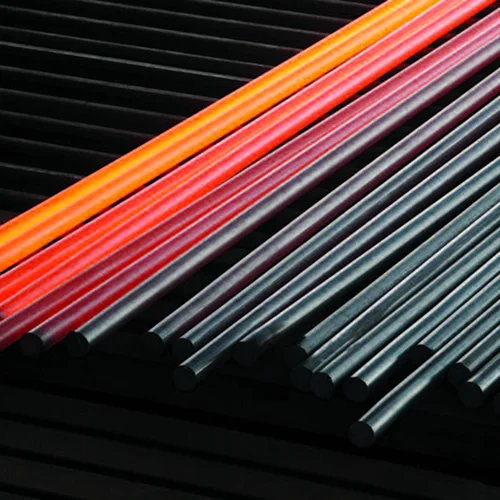
Hot rolling starts with a reheated billet, bloom or slab and passes it through a sequence of grooved or flat rolls, each pass reducing the section until the ordered size is reached. Because the steel is above its recrystallisation temperature, the grains deform and immediately reform, so the product leaves the mill with a fine, uniform structure and none of the hardening that cold work causes. Large reductions are possible in a single heat, which is why every long product and every plate begins as a hot rolled product, whatever finishing follows.
The process leaves three marks on the material. The surface carries an oxide scale that forms while the steel is hot, and beneath it a thin skin that is decarburised on carbon steel or chromium-depleted on stainless. The dimensions vary within an allowance that widens with size, because the steel shrinks as it cools and the rolls wear; EN 10060 allows about plus or minus 0.8 mm on a 50 mm round bar, and ASTM A484 states similar allowances in inch and metric tables. The section is slightly oval and the bar carries the slight bow of the cooling bed.
Stainless steel is normally supplied hot rolled, annealed and pickled, the HRAP condition. The anneal restores the softness and the corrosion resistance the rolling heat disturbed, and the pickle in mixed nitric and hydrofluoric acid removes the scale and the chromium-depleted skin beneath it. Pickling changes the surface and not the dimensions: an HRAP bar is a hot rolled bar without its scale, still within the hot rolled allowance. Hot rolled bar is the correct purchase when every surface of the finished part will be machined, because the machining allowance of 1.5 to 3 mm on diameter removes the skin and the tolerance band in one operation.
What cold rolling does
Cold rolling is a second reduction of hot rolled strip or sheet at room temperature after the scale has been pickled off. The rolls compress the metal plastically without recrystallisation, so each pass hardens the material and raises its yield strength while reducing its ductility. A thickness tolerance of a few hundredths of a millimetre is achievable, and the roll surface is printed onto the sheet, which is what gives cold rolled stainless its 2B finish (rolled, annealed, pickled and skin passed) or its bright annealed finish (annealed in a protective atmosphere so that no scale forms).
Most cold rolled strip is annealed after the final pass to restore ductility for pressing and forming, so the strength gain of the rolling is deliberately removed and only the tolerance and surface remain. Where a higher strength is wanted the strip is supplied in a temper-rolled condition, quarter hard to full hard, with the yield strength stated.
Cold rolling is not confined to flat products. Round and shaped wire is cold rolled in specialist mills between grooved rolls or through a Turk's head, threads are rolled cold on finished bar, and rings are rolled cold in bearing manufacture. What those processes have in common is a section small enough, or a shape simple enough, for the rolls to enclose. Engineering bar in the sizes ordered from a mill is finished by a different set of routes, described next, because a die surrounds the whole section at once and holds a round, hexagon or square to an ISO 286 class in a single pass, which pairs of rolls on a bar mill are not set up to do.
What cold drawing and peeling do
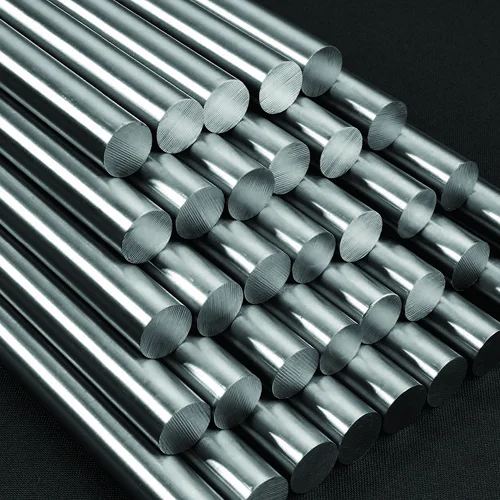
Cold drawing pulls a pickled hot rolled bar through a tungsten carbide die whose bore is slightly smaller than the bar. The reduction is a few percent on diameter, enough to size the bar to an ISO 286 class, remove the ovality, brighten the surface and raise the yield strength through work hardening. Drawn bar is supplied to h9, h10 or h11 on diameter with a surface roughness of 0.8 to 1.6 micrometres Ra, and it is straightened and cut to length after the draw. The tolerance classes and their limit deviations in millimetres are set out in a separate article.
Peeling and turning are the alternative cold finishing routes for larger bar. A rotating cutter head removes the rolled skin along with any surface seam, leaving a bar to k12 or k13 that is oversize by a controlled amount and can be ground down to an h class afterwards. Centreless grinding takes a drawn or peeled bar to h6, h7 or h8 with a surface of 0.2 to 0.4 micrometres Ra, which is the finish used for bearing seats and seals. Every one of these routes is a cold process and every one is a finishing pass on a hot rolled bar; the term bright bar covers all of them.
Strength, surface and tolerance
Cold work raises the yield strength of steel by increasing its dislocation density. A cold drawn 304 bar can show a 0.2 percent proof stress of 400 to 600 MPa against the 205 MPa minimum of the annealed condition, and a drawn carbon steel gains a comparable margin. The gain comes with a loss of elongation, and for austenitic stainless with a slight magnetic response from strain-induced martensite. Where the annealed properties are required, the bar is annealed after drawing, or ordered as peeled and ground, which removes material without deforming the core.
The surface differences follow from the process. A hot rolled bar has scale or a pickled matt surface with the seams and roll marks of the mill. A cold rolled sheet has the printed finish of the work rolls. A drawn bar has the burnished finish of the die, and a peeled bar has a fine turned finish beneath which the rolled skin is entirely gone, which is why peeled bar is specified where the surface must be free of seams, as on fasteners and pump shafts.
The tolerance follows the same order. Hot rolled allowances are stated as plus and minus values that widen with size; cold rolled thickness is held to hundredths; cold drawn and ground bar is ordered to an ISO 286 class in which the upper limit of an h class is zero, so the bar never measures over size. A class tighter than the finishing route can hold is a request for a further operation and is priced as one.
Which route produces which product
Each of the three routes ends in a different product, and the route is fixed by the form rather than chosen freely. Flat product leaves the hot strip mill as coil and is pickled and cold rolled to sheet and strip, annealed or temper rolled, and that is the only route to a thickness held in hundredths of a millimetre. Long product leaves the bar mill hot rolled, is annealed and pickled, and is then either supplied in that condition or passed through a cold finishing line, where drawing, peeling and grinding produce the tolerance classes and surfaces listed above. Structural sections and forging stock leave the mill hot rolled and take no finishing pass at all.
The number of operations sets the price in the same order. Hot rolled is the base; cold rolled adds pickling and a second rolling; cold drawn adds pickling, drawing, straightening and cutting; ground bar adds grinding, and the material removed in peeling and grinding is a yield loss carried in the price. Whether the extra pass is worth paying for depends on how much of the bar surface survives into the finished part, since a machining allowance of 1.5 to 3 mm on diameter removes a bright bar's finish along with the tolerance it was bought for. The bright bar versus black bar comparison works that trade through for a buyer.
Both conditions from one mill
Laxcon Steels rolls hot rolled round bar from 16 to 125 mm in the annealed and pickled condition, and cold finishes bright bar from 5 to 115 mm by drawing, peeling, grinding and polishing on the same site, so both conditions of a grade are rolled and finished under one roof. Traceability is by heat rather than by site: each bar carries the number of the cast it was rolled from, and the certificate states the analysis of that cast. The rolling and finishing lines are described on the technology page, and the grades rolled are listed in the grade reference.
Frequently asked questions
Is cold rolled steel stronger than hot rolled steel?
In the as-rolled condition, yes: the cold work raises the yield strength, sometimes by half or more. Most cold rolled strip is annealed after rolling to restore ductility for forming, in which case the two conditions have the same properties and differ only in surface and tolerance. The strength gain is retained only where the product is ordered in a temper-rolled or as-drawn condition.
Why is bar cold drawn rather than cold rolled?
Because a die surrounds the whole section and sizes it in one pass, holding a round, hexagon or square to an ISO 286 class and removing the ovality with it. Cold rolling of round and shaped sections does exist, in wire mills and in thread and ring rolling, but it is not how engineering bar is brought to size: drawing, peeling and grinding are the commercial routes for that, and they also remove the rolled skin.
Does HRAP mean the bar is cold finished?
No. HRAP means hot rolled, annealed and pickled: the scale has been removed in acid and the anneal has restored the properties of the grade, but the bar is still within the hot rolled dimensional allowance and carries the hot rolled surface beneath the scale. Cold finishing is a separate pass that changes the dimensions.
Which is cheaper, hot rolled or cold drawn?
Hot rolled bar is cheaper per tonne because it has had fewer operations. Cold drawn bar is cheaper for a part that uses the bar surface as supplied, because it saves the customer a machining operation and the material that would be cut away. The comparison is therefore made on the finished part, not on the bar price.
Sources
- EN 10060, Hot rolled round steel bars for general purposes: dimensions and tolerances on shape and dimensions.
- EN 10278, Dimensions and tolerances of bright steel products.
- EN 10259, Cold rolled flat products in stainless steel: tolerances on dimensions and shape.
- ASTM A484/A484M, Standard Specification for General Requirements for Stainless Steel Bars, Billets, and Forgings.
- ISO 286-1 and ISO 286-2, ISO code system for tolerances on linear sizes.
- ASM Handbook, Volume 14A, Metalworking: Bulk Forming.