EN 10088-3 and EN 10278: The European Standards for Stainless Steel Bar
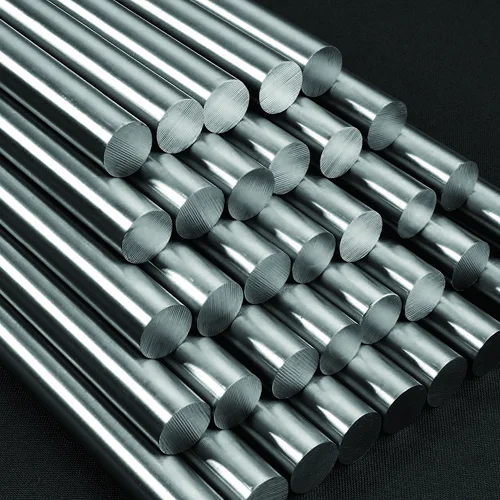
Send an enquiryEN 10088-3 is the European standard that sets the technical delivery conditions for stainless steel semi-finished products, bars, rods, wire, sections and bright products for general purposes. It is Part 3 of the five-part EN 10088 series, and its current edition, EN 10088-3:2023, replaced the 2014 edition. For each grade it fixes the chemical composition, the heat treatment conditions, the mechanical properties by product form and size, and the process routes and surface finishes in which long products are supplied. It does not fix dimensions. Those come from separate dimension standards: EN 10278 for bright bar that has been drawn, turned or ground, and EN 10060, EN 10061, EN 10059, EN 10058 and EN 10056 for hot rolled rounds, hexagons, squares, flats and angles. A European specification for stainless bar therefore names two standards, one for the material and one for the size. This article sets out the series, the content of EN 10088-3, its finish codes, EN 10278 and the hot rolled dimension standards, the construction part EN 10088-5, and the differences between EN 10088-3 and ASTM A276.
The EN 10088 series and its five parts
EN 10088 is published in five parts. Part 1 lists the stainless steels and their compositions. Parts 2 and 3 are the delivery conditions for general purposes, Part 2 for flat products and Part 3 for long products. Parts 4 and 5 are the delivery conditions for construction purposes, again divided into flat and long products. The current editions of Parts 1 and 3 date from 2023; Parts 4 and 5 date from 2009.
| Part | Products | Purpose |
|---|---|---|
| EN 10088-1 | List of stainless steels | Designation and composition of every grade in the series |
| EN 10088-2 | Sheet, plate and strip | General purposes |
| EN 10088-3 | Semi-finished products, bars, rods, wire, sections and bright products | General purposes |
| EN 10088-4 | Sheet, plate and strip | Construction purposes |
| EN 10088-5 | Bars, rods, wire, sections and bright products | Construction purposes |
The designation EN 10088 without a part number covers both the sheet and the bar parts. EN 10088-2 governs sheet, plate and strip and has no application to bar; a bar is specified to Part 3, or to Part 5 when it is a construction product. Every grade in the series carries an EN material number and a steel name under EN 10027, such as 1.4404 and X2CrNiMo17-12-2 for the grade known as 316L. The numbering is explained in the steel grades article.
EN 10088-3: technical delivery conditions for bar
EN 10088-3 applies to semi-finished products, hot or cold formed bars, rods, wire and sections, and bright products, in the standard and special grades of corrosion resisting steel for general purposes. Its scope includes stainless steels for use in contact with foodstuffs. It is used together with EN 10021, the general technical delivery requirements for steel products, in the same way that ASTM A484 serves the ASTM bar specifications.
For each grade the standard sets a composition window, the heat treatment conditions in which the grade is supplied, and the mechanical properties in each condition by product form and size band. The condition is written as a symbol after the grade: +A for annealed, used for the ferritic and martensitic grades; +AT for solution annealed, used for the austenitic and duplex grades; +QT for quenched and tempered, followed by a strength level; +P for precipitation hardened; and +C for cold work hardened. For 1.4404 bar up to 160 mm in the +AT condition, the standard sets a 0.2 percent proof stress of at least 200 MPa, a 1 percent proof stress of at least 235 MPa, a tensile strength of 500 to 700 MPa, an elongation of at least 40 percent measured longitudinally, and an impact energy of at least 100 J. Between 160 and 250 mm the elongation and impact energy are measured transversely, with minima of 30 percent and 60 J, and above 250 mm the properties are agreed between the parties.
The 2023 edition added austenitic, duplex and martensitic grades, altered the compositions of some austenitic, ferritic and martensitic grades, and withdrew grades no longer in use. It revised the mechanical values for austenitic bright bar, introduced mechanical values for martensitic bright bar, and permitted modelling as a means of determining tensile properties.
Process routes and surface finishes
EN 10088-3 describes the process route and surface of a long product with a two-character code. The digit 1 denotes a hot formed product and the digit 2 a product cold processed after hot forming; the letter names the route. The codes used for bar are listed below.
| Code | Process route | Surface |
|---|---|---|
| 1U | Hot formed, not heat treated, not descaled | Covered with rolling scale |
| 1C | Hot formed, heat treated, not descaled | Covered with rolling scale |
| 1E | Hot formed, heat treated, mechanically descaled | Largely free of scale |
| 1D | Hot formed, heat treated, pickled | Free of scale |
| 1X | Hot formed, heat treated, rough machined by peeling or turning | Metallic, machining marks may remain |
| 2H | Cold processed from 1E, 1D or 1X, usually by drawing | Smooth, matt or bright |
| 2D | 2H, then heat treated and pickled | Smooth, matt |
| 2B | 1E, 1D or 1X, mechanically smoothed | Smoother than 1E, 1D or 1X |
| 2G | 2H, 2D or 2B, centreless ground | Smooth and uniform |
| 2P | 2H, 2D, 2B or 2G, polished | Smoother and brighter than 2B or 2G |
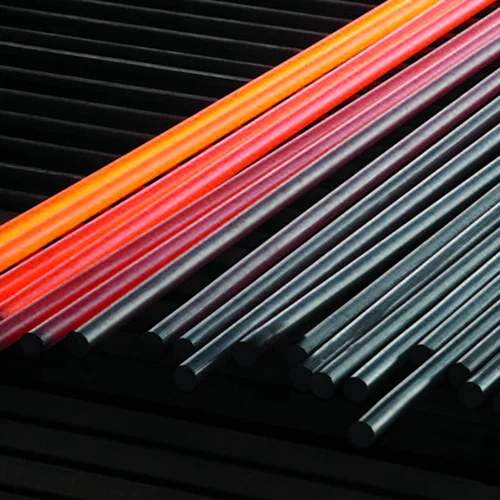
The codes correspond to the trade names for bar. A black bar is 1U or 1C, according to whether it was heat treated after rolling. A hot rolled, annealed and pickled bar, known as HRAP, is 1D. A peeled bar is 1X. A cold drawn bright bar is 2H, a ground bar 2G and a polished bar 2P. A finish code states the route and the surface. It does not state a tolerance, which for the bright finishes is set under EN 10278.
EN 10278: dimensions and tolerances of bright bar
EN 10278 is the European standard for the dimensions and tolerances of bright steel products. Its 2023 edition, titled Dimensions and tolerances of bright steel products of stainless and other special steels, replaced EN 10278:1999. It applies to bright products in the drawn, turned or ground condition delivered in straight lengths, and it is mainly applied to the stainless steels of EN 10088-3 and to other special steels such as tool steels and rolling bearing steels. The non-alloy and alloy bright steels of EN 10277 are no longer within its scope, and cold rolled products cut from strip or sheet are excluded. The standard may also be used for cold heading steels as bar and wire; for wire, the size tolerances apply but the length and straightness requirements do not.
EN 10278 states the tolerance on the cross-section as an ISO 286 tolerance class and adds requirements on straightness and length. The class follows the finishing route. Cold drawn round bar is held to h9 to h11. Peeled or smooth turned bar is held to h9 and h10, or to k12 and k13 when it is left oversize for a later grinding pass. Centreless ground bar is held to h7 to h9. Drawn hexagon and square bar are held to h11 across the flats, and drawn flat bar to h11 on both width and thickness. The h classes place the whole tolerance below the nominal size and the k12 and k13 classes place it above. The deviations in millimetres for each class and diameter are tabulated in the tolerance classes article.
Dimension standards for hot rolled bar
Hot rolled bar takes its dimensions and tolerances from a standard for each section. Most of these standards are written for hot rolled steel sections in general, not for stainless steel alone, and they apply to stainless bar when the specification names them.
| Standard | Section |
|---|---|
| EN 10060 | Hot rolled round bar |
| EN 10061 | Hot rolled hexagon bar |
| EN 10059 | Hot rolled square bar |
| EN 10058 | Hot rolled flat bar |
| EN 10056-1 and EN 10056-2 | Equal and unequal leg angles: dimensions (Part 1) and tolerances (Part 2) |
| EN 10279 | Hot rolled channels |
| EN 10055 | Hot rolled equal flange tees with radiused root and toes |
A hot rolled tolerance is a plus-and-minus allowance about the nominal size that widens with the size, and not an ISO 286 class. A 50 mm round bar under EN 10060 may run about 0.8 mm either side of nominal. The same diameter drawn to h9 under EN 10278 runs 0.062 mm under nominal and nothing over. The wider allowance exists because hot rolled bar is machined on every surface, and the machining allowance absorbs it. The comparison between black and bright bar is developed in the bright bar and black bar article.
EN 10088-5: bar for construction
EN 10088-5 sets the technical delivery conditions for bars, rods, wire, sections and bright products of corrosion resisting steels for construction purposes. It is a harmonised standard under the Construction Products Regulation, Regulation (EU) No 305/2011, and its Annex ZA sets out how the constancy of performance of the product is assessed and verified. A product within its scope is CE marked. Under assessment system 2+, a notified body certifies the manufacturer's factory production control and keeps it under annual surveillance, and the manufacturer declares the performance of the product. Stainless bar placed on the European market as a construction product is therefore supplied to Part 5, while the same grade supplied for a machined component is supplied to Part 3.
EN 10088-3 against ASTM A276
EN 10088-3 and ASTM A276 cover the same bar and differ in method. ASTM A276 designates a grade by UNS number and states minimum values that apply to all sizes of hot-finished bar in a condition. EN 10088-3 designates a grade by material number and states its values by size band, with a maximum as well as a minimum for tensile strength, a 1 percent proof stress for the austenitic grades, and an impact energy. The elongation is measured on different gauge lengths: 50 mm under ASTM, and 5.65 times the square root of the cross-section under EN, so the two percentages are not compared without conversion.
| Requirement | EN 10088-3, 1.4404 +AT, up to 160 mm | ASTM A276, S31603, hot finished, Condition A |
|---|---|---|
| 0.2 percent proof stress, minimum | 200 MPa | 170 MPa |
| 1 percent proof stress, minimum | 235 MPa | Not specified |
| Tensile strength | 500 to 700 MPa | 485 MPa minimum |
| Elongation, minimum | 40 percent, longitudinal | 40 percent, 50 mm gauge |
| Impact energy, minimum | 100 J, longitudinal | Not specified |
| Size dependence | Values by size band to 250 mm; agreed above | One set of values for all sizes |
The composition windows differ as well. In the Laxcon grade register, 1.4404 allows 2.0 to 2.5 percent molybdenum and up to 1.0 percent silicon, while AISI 316L allows 2.0 to 3.0 percent molybdenum and up to 0.75 percent silicon. A heat inside both windows can be supplied to both standards; a heat at 2.8 percent molybdenum meets the ASTM window and not the EN one. The condition symbols correspond in kind, not in value: +AT to Condition A for the austenitic grades, +QT to Conditions H and T for the martensitic grades, +C to the strain-hardened Conditions S and B, and +P to the aged conditions of ASTM A564. Nearest counterparts by grade are listed in the equivalents tables.
EN bar from Laxcon Steels
Laxcon Steels melts, rolls and finishes stainless steel bar at Sanand, Gujarat. Its bright bar, from 5 to 115 mm, names EN 10088-3 and EN 10278 among its governing standards and is supplied to h7, h8, h9, h10, h11, k12 and k13. Its hot rolled round bar, from 16 to 125 mm, names EN 10088-3 and EN 10060. The hexagon, square, flat and angle pages name EN 10061, EN 10059, EN 10058 and EN 10056 respectively. TÜV NORD Systems, as notified body 0045, certifies the factory production control of Laxcon Steels for bars, rods, sections and bright products of corrosion resisting steels for construction purposes to EN 10088-5 under system 2+. The same body recognises Laxcon Steels as a material manufacturer under AD 2000-Merkblatt W 0 and has assessed its quality management system for material for pressure equipment under Directive 2014/68/EU, Annex I, point 4.3. The certificates are listed on the quality page.
Frequently asked questions
What is EN 10088-3?
EN 10088-3 is the European standard for the technical delivery conditions of stainless steel semi-finished products, bars, rods, wire, sections and bright products for general purposes. It sets each grade's composition, heat treatment conditions, mechanical properties and surface finishes. The current edition is EN 10088-3:2023.
What is the difference between EN 10088-2 and EN 10088-3?
EN 10088-2 covers stainless steel sheet, plate and strip for general purposes. EN 10088-3 covers semi-finished products, bars, rods, wire, sections and bright products for general purposes. A bar is specified to Part 3, never to Part 2.
What does +AT mean in EN 10088-3?
+AT is the symbol for the solution annealed condition, used for the austenitic and duplex grades. It is written after the grade, as in 1.4404+AT, and it corresponds in kind to Condition A of ASTM A276. Other symbols are +A for annealed, +QT for quenched and tempered, +P for precipitation hardened and +C for cold work hardened.
What does EN 10278 specify?
EN 10278 specifies the dimensions and tolerances of bright steel products of stainless and other special steels: drawn, turned or ground bar delivered in straight lengths. It states the tolerance on the section as an ISO 286 class, such as h9 or k12, with requirements on straightness and length. It does not apply to hot rolled bar.
What is the ASTM equivalent of EN 10088-3?
ASTM A276 is the nearest ASTM counterpart for stainless steel bar for general purposes, and ASTM A479 for bar used in boilers and pressure vessels. Both take their dimensional tolerances from ASTM A484, where a European specification takes them from EN 10278 or the hot rolled dimension standards.
Sources
- EN 10088-1:2023, Stainless steels, Part 1: list of stainless steels.
- EN 10088-2, Stainless steels, Part 2: technical delivery conditions for sheet/plate and strip of corrosion resisting steels for general purposes.
- EN 10088-3:2023, Stainless steels, Part 3: technical delivery conditions for semi-finished products, bars, rods, wire, sections and bright products of corrosion resisting steels for general purposes.
- EN 10088-4:2009 and EN 10088-5:2009, Stainless steels, Parts 4 and 5: technical delivery conditions for corrosion resisting steels for construction purposes.
- EN 10278:2023, Dimensions and tolerances of bright steel products of stainless and other special steels.
- EN 10060, EN 10061, EN 10059, EN 10058, EN 10056-1 and EN 10056-2, EN 10279 and EN 10055, dimensions and tolerances of hot rolled steel sections.
- EN 10021, General technical delivery requirements for steel products.
- EN 10027-1 and EN 10027-2, Designation systems for steels.
- ISO 286-1 and ISO 286-2, ISO code system for tolerances on linear sizes.
- Regulation (EU) No 305/2011, the Construction Products Regulation.
- ASTM A276/A276M-25, Standard Specification for Stainless Steel Bars and Shapes.