Steel Grades Explained: How the AISI, EN, UNS, IS and JIS Numbering Systems Work
Send an enquiryA steel grade is a designation that fixes the chemical composition of a steel, and often its mechanical properties and delivery condition, by reference to a published standard. The same steel carries a different name in each system: the austenitic stainless steel that the American AISI system calls 304 is 1.4301 or X5CrNi18-10 in the European EN system, S30400 in the UNS system, SUS304 in the Japanese JIS system and X04Cr19Ni9 in the Indian IS system. A grade number is a key into the standard that defines it, and the standard, not the number, is what a mill certifies against.
AISI and SAE numbers
The American system has two parts. Carbon and alloy steels carry a four-digit SAE number, in which the first digit names the alloy family, the second the approximate content of the principal alloying element, and the last two the carbon content in hundredths of a percent. A 10xx steel is plain carbon, a 41xx steel is chromium-molybdenum, a 43xx steel is nickel-chromium-molybdenum, an 86xx steel is a leaner nickel-chromium-molybdenum, and a 92xx steel is silicon-manganese. So 4140 is a chromium-molybdenum steel with 0.40 percent carbon, 4340 is a nickel-chromium-molybdenum steel with 0.40 percent carbon, 8620 is a case-hardening steel with 0.20 percent carbon, and 1045 is a plain carbon steel with 0.45 percent.
Stainless steels carry a three-digit AISI number that names the family: the 200 series is chromium-nickel-manganese austenitic, the 300 series chromium-nickel austenitic, the 400 series chromium ferritic and martensitic, and the 600 series covers the precipitation hardening grades, of which 630 is 17-4 PH. The digits after the family carry no rule; 304, 316 and 321 are simply the numbers the grades were given. A suffix does carry a rule: L is low carbon (0.03 percent maximum), H is high carbon for elevated temperature strength, S in 310S is a lower-carbon variant, Ti and Nb mark stabilisation, and N marks added nitrogen. The ASTM bar standards A276 and A479 now define the grades by their UNS numbers, with the AISI number kept as the common name.
EN numbers and names
The European system, EN 10027, gives every steel both a number and a name. The number, from EN 10027-2 and older German Werkstoff practice, has the form 1.xxxx: the 1 means steel, the next two digits name the group and the last two are a serial number within it. Groups 1.00 to 1.09 are unalloyed steels, 1.40 to 1.45 stainless steels, 1.70 to 1.79 chromium and chromium-molybdenum alloy steels, and 1.65 and 1.66 nickel-chromium-molybdenum steels. Hence 304 is 1.4301, 316L is 1.4404, 42CrMo4 (the equivalent of 4140) is 1.7225 and 34CrNiMo6 (the equivalent of 4340) is 1.6582.
The name, from EN 10027-1, states the composition. For a high-alloy steel the name starts with X, then the carbon content in hundredths of a percent, then the alloying elements in descending order of content with their percentages: X5CrNi18-10 is 0.05 percent carbon, 18 percent chromium, 10 percent nickel. For a low-alloy steel the X is dropped and the element contents are multiplied by a factor (4 for chromium, manganese, nickel and silicon; 10 for molybdenum and vanadium) so that small percentages become whole numbers: 42CrMo4 is 0.42 percent carbon and 1 percent chromium. Plain carbon steels are named by carbon content (C45) and structural steels by minimum yield strength (S355).
UNS numbers
The Unified Numbering System, kept jointly by ASTM and SAE, is not a specification but a registry that gives one number to each composition so that the different American standards can refer to the same steel. A UNS number is a letter and five digits. S is stainless and heat-resisting steels, G is the SAE carbon and alloy steels, K is miscellaneous steels, N is nickel alloys, R is reactive and refractory metals and T is tool steels. Where the AISI number exists it is embedded: 304 is S30400, 316L is S31603, 4140 is G41400. Grades that never had an AISI number carry only the UNS: duplex 2205 is S32205, super duplex 2507 is S32750, Inconel 600 is N06600. A UNS number fixes composition only; properties and product form come from the ASTM standard that invokes it.
Indian Standard designations
The Bureau of Indian Standards designates steels by a composition code that resembles the EN name. Under IS 1570 the code gives the carbon content in hundredths of a percent, then the manganese content multiplied by ten or the alloying elements with their contents multiplied by four: 45C8 is 0.45 percent carbon with about 0.8 percent manganese, 40Cr4Mo3 is 0.40 percent carbon with 1 percent chromium and 0.3 percent molybdenum (the equivalent of EN19), and 40Ni2Cr1Mo28 is the nickel-chromium-molybdenum steel corresponding to EN24. Stainless steels under IS 6603, the specification for stainless steel bars and flats, and IS 6911 for plate, sheet and strip, are coded X, carbon in hundredths, then the elements: X04Cr19Ni9 is 304, X02Cr19Ni10 is 304L and X04Cr17Ni12Mo2 is 316. The grade list is not fixed: the 2024 revision of IS 6603 extends it to the duplex and precipitation hardening steels that earlier editions left out, so Indian designations now exist for 2205 and for 630 where older cross-reference tables show none. Structural steel under IS 2062 is named by yield strength, E250 and E350, and reinforcing bar under IS 1786 as Fe 500 or Fe 550.
The British EN series: EN8, EN19, EN24
The EN in EN8, EN19, EN24 and EN31 has nothing to do with European standards. It stands for Emergency Number, the numbering given to British wartime steel specifications in the 1940s and carried forward into BS 970:1955, and the series survives in India and the United Kingdom as the everyday name for engineering steels more than fifty years after BS 970:1970 replaced it with six-character codes. EN8 became 080M40 (a 0.40 percent carbon steel), EN19 became 709M40 (chromium-molybdenum, the equivalent of 42CrMo4 and 4140), EN24 became 817M40 (nickel-chromium-molybdenum, the equivalent of 34CrNiMo6 and 4340), and EN31 became 534A99 (the 1 percent carbon chromium bearing steel, 52100).
JIS designations
The Japanese Industrial Standards use a letter code: SUS is stainless steel (SUS304, SUS316L, SUS430), S with the carbon content and C is a plain carbon steel (S45C corresponds to C45 and 1045), SCM is chromium-molybdenum (SCM440 corresponds to 42CrMo4 and 4140), SNCM is nickel-chromium-molybdenum (SNCM439 corresponds to 4340) and SUJ2 is the bearing steel corresponding to 52100.
Steel grades chart: cross-reference
The equivalence between systems is close but never exact: each standard sets its own composition window, and a grade certified to one standard is not automatically within the window of another. Where an order needs both, the mill certifies to both.
| AISI / SAE / common | EN number | EN name | UNS | IS | JIS |
|---|---|---|---|---|---|
| 304 | 1.4301 | X5CrNi18-10 | S30400 | X04Cr19Ni9 | SUS304 |
| 304L | 1.4307 | X2CrNi18-9 | S30403 | X02Cr19Ni10 | SUS304L |
| 316 | 1.4401 | X5CrNiMo17-12-2 | S31600 | X04Cr17Ni12Mo2 | SUS316 |
| 316L | 1.4404 | X2CrNiMo17-12-2 | S31603 | X02Cr17Ni12Mo2 | SUS316L |
| 321 | 1.4541 | X6CrNiTi18-10 | S32100 | X04Cr18Ni10Ti | SUS321 |
| 410 | 1.4006 | X12Cr13 | S41000 | X12Cr12 | SUS410 |
| 420 | 1.4021 | X20Cr13 | S42000 | X20Cr13 | SUS420J1 |
| 430 | 1.4016 | X6Cr17 | S43000 | X04Cr17 | SUS430 |
| 2205 duplex | 1.4462 | X2CrNiMoN22-5-3 | S32205 | IS 6603:2024 | SUS329J3L |
| 17-4 PH (630) | 1.4542 | X5CrNiCuNb16-4 | S17400 | IS 6603:2024 | SUS630 |
| EN8 / 1040 | 1.0511 | C40 | G10400 | 40C8 | S40C |
| EN19 / 4140 | 1.7225 | 42CrMo4 | G41400 | 40Cr4Mo3 | SCM440 |
| EN24 / 4340 | 1.6582 | 34CrNiMo6 | G43400 | 40Ni2Cr1Mo28 | SNCM439 |
| EN31 / 52100 | 1.3505 | 100Cr6 | G52986 | 103Cr1 | SUJ2 |
The two cells naming IS 6603:2024 mark grades that only the 2024 revision of that standard brought into the Indian stainless bar specification; their designations are read from that edition rather than carried over from an older table.
Steel grades by family
Across every system the grades fall into the same families, and the family predicts the behaviour of a steel before the composition is read. Plain carbon steels (10xx, C-grades, EN8) are named by carbon content and hardened by it. Low alloy steels (41xx, 43xx, 86xx, EN19, EN24) add chromium, molybdenum and nickel for hardenability in larger sections. Austenitic stainless steels (300 series) have chromium and nickel, do not harden by heat treatment and are non-magnetic when annealed. Ferritic stainless steels (430) have chromium alone and are magnetic. Martensitic stainless steels (410, 420, 431) harden by quenching. Duplex stainless steels (2205, 2507) have about twice the yield strength of the austenitic grades. Precipitation hardening grades (17-4 PH, 15-5 PH) harden by ageing. Each family has its own page in the grade reference, and the equivalents table extends the cross-reference above to every grade the reference covers.
Reading a grade on a certificate
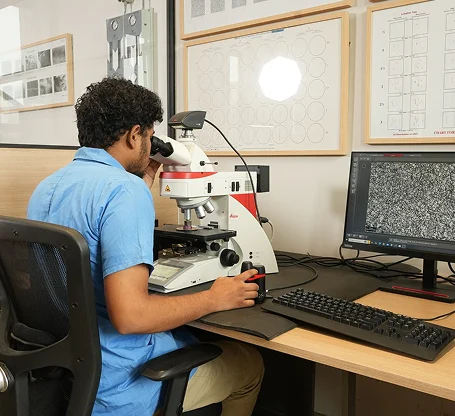
A mill test certificate to EN 10204 names the grade and the standard it was made to, then reports the heat analysis element by element. The analysis is read against the composition window of that standard: a heat certified as 304 to ASTM A276 must fall inside A276's window for S30400, which differs in small ways from EN 10088-3's window for 1.4301. When a certificate lists two grades, such as 304/304L, the heat satisfies both windows and either may be invoked. The laboratory produces the analysis by optical emission spectrometry on a sample from the heat, and the heat number connects the bar to the certificate.
Grades as bar
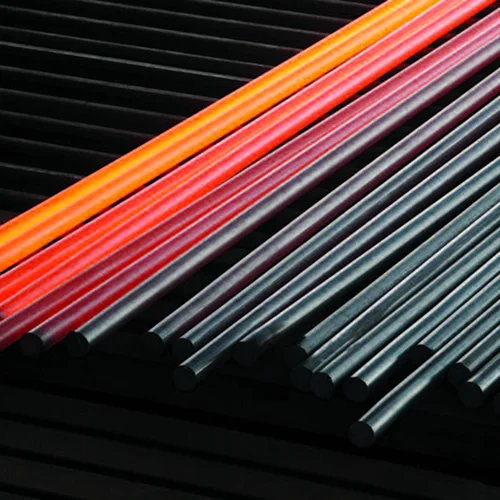
Laxcon Steels melts and rolls the austenitic, ferritic, martensitic, duplex and precipitation hardening stainless grades in the chart above, together with carbon and alloy engineering steels, as hot rolled round bar from 16 to 125 mm and bright bar, and certifies each heat to the standard named on the order, ASTM, EN or IS, with dual certification where the heat meets both windows.
Frequently asked questions
What is the difference between 304 and 1.4301?
They are the same steel in two naming systems: 304 is the American AISI number and 1.4301 the European EN number, with X5CrNi18-10 as its EN name. The composition windows of ASTM A276 and EN 10088-3 differ slightly, so a heat is certified to whichever standard the order names, or to both.
What do the four digits of an SAE steel number mean?
The first digit is the alloy family (1 carbon, 4 molybdenum, 8 nickel-chromium-molybdenum), the second the principal alloy content, and the last two the carbon content in hundredths of a percent. So 4140 is a chromium-molybdenum steel with 0.40 percent carbon.
Is EN8 a European standard grade?
No. The EN of EN8, EN19 and EN24 stands for Emergency Number, from the British wartime steel specifications of the 1940s that BS 970:1955 carried forward. EN8 is 080M40 in the later BS 970 numbering, close to C40 and SAE 1040; EN19 is 709M40, the equivalent of 42CrMo4 and 4140; EN24 is 817M40, the equivalent of 34CrNiMo6 and 4340.
What does the L in 304L or 316L mean?
L is low carbon: 0.03 percent maximum instead of 0.08. The lower carbon prevents chromium carbide from forming beside a weld, which would otherwise leave a zone open to intergranular corrosion. A heat that meets both windows is certified as 304/304L.
Sources
- EN 10027-1 and EN 10027-2, Designation systems for steels: steel names and numbers.
- ASTM E527 and SAE J1086, Practice for Numbering Metals and Alloys in the Unified Numbering System.
- ASTM A276/A276M and EN 10088-3, the stainless bar standards whose composition windows define the grades.
- IS 1570 (Parts 1 to 5), Schedules for wrought steels; IS 6603:2024, Stainless steel bars and flats, whose 2024 revision extends the grade list to the duplex and precipitation hardening steels; IS 2062, Structural steel.
- BS 970:1955 and BS 970:1970, Wrought steels for mechanical and allied engineering purposes.
- JIS G 4303, Stainless steel bars; JIS G 4053, Low-alloyed steels for machine structural use.