4140 and 4340 Alloy Steel Bar: 42CrMo4, 34CrNiMo6, EN 19 and EN 24 Compared
Send an enquiry4140 and 4340 are medium-carbon low-alloy steels of the SAE system that are hardened by quenching and tempering for shafts, axles, gears, studs and other parts loaded through their whole section. 4140 is a chromium-molybdenum steel. 4340 carries the same elements with about 1.8 percent nickel added and is a nickel-chromium-molybdenum steel. Both hold 0.38 to 0.43 percent carbon, so both reach a similar hardness where they are fully hardened. They differ in hardenability: the depth to which a quench hardens a bar. 4340 hardens deeper and keeps more toughness at a given strength, which is why it is chosen for heavy sections and severe duty. In Europe the counterparts are 42CrMo4 (material number 1.7225) and 34CrNiMo6 (1.6582), named in EN 10083-3 and now in EN ISO 683-2. In British practice they are EN 19 and EN 24. The three systems describe two families of steel, but the pairs across them are not identical, and the limits of each equivalence decide whether one heat can meet the composition of two names.
Chromium-molybdenum and nickel-chromium-molybdenum steels
In the SAE four-digit system the first two digits name the alloy series and the last two the mean carbon content in hundredths of a percent. The 41 series is chromium-molybdenum steel; the 43 series is nickel-chromium-molybdenum steel. 4140 and 4340 are therefore the 0.40 percent carbon members of two series, and their alloying additions do different work.
Chromium and molybdenum slow the transformation of austenite to ferrite and pearlite during cooling, so martensite can form at a lower cooling rate than in plain carbon steel. Molybdenum also resists softening on tempering and reduces the embrittlement that some alloy steels suffer when tempered or slowly cooled in certain temperature ranges. Nickel adds a further delay to the transformation and strengthens and toughens the ferrite of the tempered structure. The result is a steel that reaches the same tensile strength as 4140 at a greater depth below the surface, with a higher impact energy at that strength. Neither steel resists corrosion: their chromium content is far below the roughly 10.5 percent at which steel forms a passive film. The alloy steel family page sets out the through-hardening group to which both belong and how it differs from the case-hardening group.
Composition of 4140, 4340, 42CrMo4 and 34CrNiMo6
The SAE compositions are published in SAE J404 and printed for bar in ASTM A322, which covers alloy steel bars and calls up ASTM A29 for the general requirements of hot-wrought bar. The European compositions are the cast analyses of EN 10083-3:2006; EN ISO 683-2:2018 gives the same limits for the elements in the tables. The first table compares chromium, nickel and molybdenum, the alloying elements that separate the grades; the second gives carbon and manganese. Both are in weight percent.
| Grade | Chromium | Nickel | Molybdenum |
|---|---|---|---|
| 4140 | 0.80 to 1.10 | None specified | 0.15 to 0.25 |
| 42CrMo4 (1.7225) | 0.90 to 1.20 | None specified | 0.15 to 0.30 |
| 4340 | 0.70 to 0.90 | 1.65 to 2.00 | 0.20 to 0.30 |
| 34CrNiMo6 (1.6582) | 1.30 to 1.70 | 1.30 to 1.70 | 0.15 to 0.30 |
| Grade | Carbon | Manganese |
|---|---|---|
| 4140 | 0.38 to 0.43 | 0.75 to 1.00 |
| 42CrMo4 (1.7225) | 0.38 to 0.45 | 0.60 to 0.90 |
| 4340 | 0.38 to 0.43 | 0.60 to 0.80 |
| 34CrNiMo6 (1.6582) | 0.30 to 0.38 | 0.50 to 0.80 |
EN 10083-3 caps phosphorus at 0.025 percent and sulphur at 0.035 percent for both European grades. ASTM A322 allows 0.035 percent phosphorus and 0.040 percent sulphur for the SAE grades. EN 10083-3 also lists 42CrMoS4 (1.7227), a variant of 42CrMo4 with sulphur held between 0.020 and 0.040 percent to improve machinability. The two European grades differ from each other by more than nickel: 34CrNiMo6 has less carbon than 42CrMo4 and about 40 percent more chromium. Because its carbon is lower, the greater strength it is required to give in heavy sections comes from its alloy content.
Hardenability and section size
The centre of a bar cools more slowly than its surface in any quench, and the difference grows with diameter. A steel of low hardenability forms martensite at the surface and softer ferrite, pearlite or bainite at the centre of a large bar, so after tempering its core is weaker than its rim. A steel of high hardenability forms martensite deeper, and the tempered properties are more even across the section. Carbon sets the hardness that martensite can reach; the alloy content sets how deep it reaches.
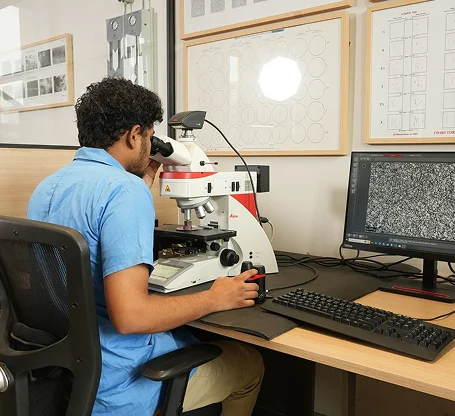
Hardenability is measured by the end-quench test of EN ISO 642, also defined as ASTM A255 and known as the Jominy test. A standard bar is austenitised, for 42CrMo4 at 850 degrees Celsius, and quenched by a water jet on one end face only. Hardness is then measured along the bar at stated distances from the quenched end, and the curve that results reads cooling rate as distance. A steel ordered with a hardenability requirement is held to a band on this curve rather than to composition alone. EN 10083-3 defines three such conditions: +H for the normal band, +HH for a narrowed band in the upper part of that range, and +HL for a narrowed band in its lower part. The SAE system expresses the same idea with the H grades, 4140H and 4340H, which allow a slightly wider composition so that the mill can hold the hardenability inside the band.
Quenched and tempered strength by section
An SAE grade fixes composition and nothing else. A 4140 or 4340 bar acquires a strength only from the specification it is ordered to, such as ASTM A434 for quenched and tempered alloy steel bar, ASTM A193 for 4140 bolting, ASTM A320 for 4340 bolting in low-temperature service, or an aerospace material specification. EN 10083-3 differs: it gives each grade required properties in the quenched and tempered condition (+QT) by diameter band. The bands are 16 mm and under, over 16 to 40 mm, over 40 to 100 mm, over 100 to 160 mm and over 160 to 250 mm. For flat bar the same bands are set by thickness, so that 8 to 20 mm thick corresponds to 16 to 40 mm in diameter. The size is the size at heat treatment.
For 42CrMo4 the minimum yield strength falls from 750 MPa in the 16 to 40 mm band, with a tensile strength of 1,000 to 1,200 MPa, to 550 MPa in the 100 to 160 mm band, with 800 to 950 MPa, and to 500 MPa over 160 mm. For 34CrNiMo6 the minimum yield strength in the same bands is 900, 700 and 600 MPa, with tensile ranges of 1,100 to 1,300, 900 to 1,100 and 800 to 950 MPa. In every band the nickel grade is required to give 100 to 150 MPa more yield strength than the chromium-molybdenum grade. The two grades differ in toughness requirements as well. The minimum Charpy V-notch energy on longitudinal specimens, an average of three, is 35 joules for 42CrMo4 and 45 joules for 34CrNiMo6 in each band above 16 mm. No single value may fall below 70 percent of that average.
The same figures show the effect of section size. A 42CrMo4 bar heat treated at 120 mm is required to give only 550 MPa yield, less than the 650 MPa it must give at 60 mm. A 34CrNiMo6 bar at 120 mm must still give 700 MPa, more than 42CrMo4 at 60 mm. Producer datasheets that follow the standard give hardening at 820 to 880 degrees Celsius in oil or water for 42CrMo4 and at 830 to 860 degrees in oil for 34CrNiMo6, with tempering between about 540 and 680 degrees, at the upper end of the tempering temperatures described in the heat treatment of steel article.
EN 10083-3 designations: 42CrMo4 and 34CrNiMo6
EN 10083-3 is the European standard for the technical delivery conditions of alloy steels for quenching and tempering. Its 2006 edition covered bar, rod, flat products and forgings among other product forms. In 2018 CEN replaced it with EN ISO 683-2, the unmodified European adoption of ISO 683-2:2016, which keeps 42CrMo4, 34CrNiMo6 and their material numbers. Drawings and orders made before 2018 may cite EN 10083-3, and the grade names they use are unchanged in its replacement.
The steel names follow EN 10027-1. The leading figure is the mean carbon content multiplied by 100, the symbols of the main alloying elements follow, and the closing figure is the chromium content multiplied by four. 42CrMo4 is therefore a steel of about 0.42 percent carbon and 1 percent chromium that also contains molybdenum. 34CrNiMo6 is a steel of about 0.34 percent carbon and 1.5 percent chromium that also contains nickel and molybdenum. The name does not state the nickel or molybdenum content. The material numbers 1.7225 and 1.6582 come from EN 10027-2 and identify the same steels by number.
A suffix after the name gives the delivery condition. The standard's symbols include +A for soft annealed, +S for treated to improve shearability, +QT for quenched and tempered and the hardenability symbols +H, +HH and +HL. 42CrMo4+A is limited to 241 HB and 42CrMo4+S to 255 HB. 34CrNiMo6+A is limited to 248 HB.
BS 970 names: EN 19 and EN 24
EN 19 and EN 24 are grade numbers listed in the 1955 edition of BS 970, the British standard for wrought engineering steels. Later editions renamed them 709M40 and 817M40, where the first three digits place the steel in the chromium-molybdenum or nickel-chromium-molybdenum group, the M means supply to mechanical properties and the 40 is the mean carbon content in hundredths of a percent. BS 970-1:1996 has been withdrawn, and European standards, among them EN 10083 for quenched and tempered steels, took its place. The older names remain in use on drawings and orders, in India and the United Kingdom among other markets. The BS grades are bought to a condition letter, such as T for 850 to 1,000 MPa tensile, within a limiting ruling section. EN 19 corresponds to 4140 and 42CrMo4, and EN 24 corresponds to 4340 and 34CrNiMo6. The EN steel grades article explains the numbering, and the EN 24 grade page compares EN 24 with 4340 element by element.
Where the equivalents differ
4140 and 42CrMo4 overlap closely. Their ranges for carbon, molybdenum and silicon nest one inside the other, with the 4140 range the narrower, and their manganese and chromium ranges overlap: manganese between 0.75 and 0.90 percent and chromium between 0.90 and 1.10 percent satisfy both. A heat inside the 4140 ranges for carbon, silicon and molybdenum, inside those windows for manganese and chromium, and with phosphorus at 0.025 percent or less and sulphur at 0.035 percent or less meets both compositions. 42CrMo4 with 1.15 percent chromium or 0.44 percent carbon is not 4140, and 4140 with 0.85 percent chromium or 0.95 percent manganese is not 42CrMo4. Whether one heat meets both names therefore depends on its cast analysis, not on the grade names.
4340 and 34CrNiMo6 do not overlap in this way. Their chromium ranges, 0.70 to 0.90 percent and 1.30 to 1.70 percent, have no value in common, and their carbon ranges meet only at 0.38 percent. No heat can satisfy both compositions. 4340 carries more nickel and carbon, and 34CrNiMo6 more chromium. Producer datasheets list each as the counterpart of the other because both are deep-hardening nickel-chromium-molybdenum steels for similar parts, but they are not one steel under two names. A substitution between them is a change of material that the designer approves.
Selection by section, strength and toughness
The choice between the two families rests on three properties of the part: the section at heat treatment, the strength required at the point of highest stress, and the toughness required at the service temperature. A chromium-molybdenum steel, 4140 or 42CrMo4, serves shafts, pins, gears and studs of small and medium section. EN 10083-3 requires 42CrMo4+QT to give 1,000 to 1,200 MPa tensile at 16 to 40 mm and 900 to 1,100 MPa at 40 to 100 mm. As the section grows past that, the strength the steel can be relied on to give falls band by band.
A nickel-chromium-molybdenum steel, 4340 or 34CrNiMo6, is chosen when the section is too large for the chromium-molybdenum grade to reach the required strength through its depth. It is also chosen when a high strength must be combined with a high impact energy, or when the part must stay tough at low temperature. In a small section at a moderate strength its added alloy brings no property that the part uses. Both families are difficult to weld, because their carbon and alloy content gives a hard heat-affected zone, and welded parts need preheat, a qualified procedure and a post-weld temper. Parts that need a hard wear surface over a tough core are often made in a case-hardening steel instead.
4140 and 4340 bar from Laxcon Steels
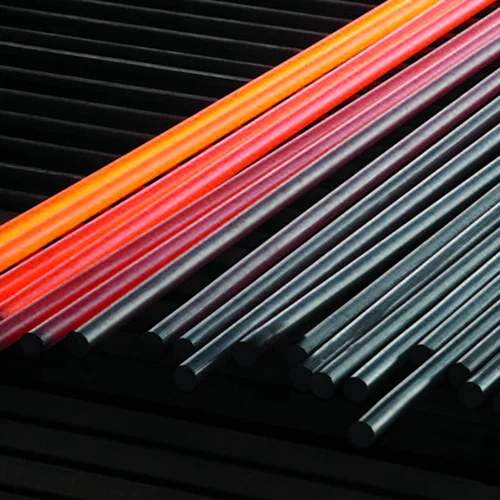
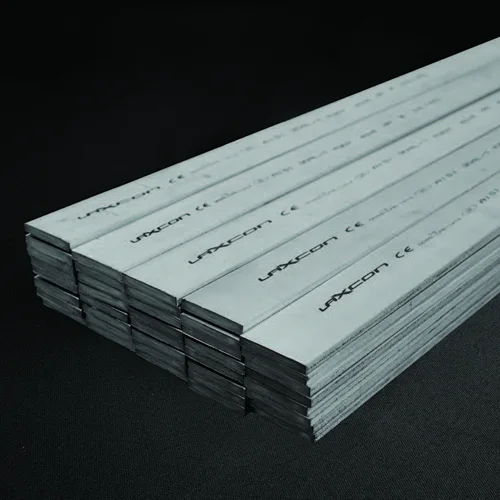
Laxcon Steels supplies hot rolled round bar from 16 to 125 mm in SAE 4140, SAE 4340, EN 19 and EN 24, and hot rolled annealed and pickled flat bar in SAE 4140 and SAE 4340. Hexagonal and square bright bar are also made in SAE 4140. Every product, shape and size is made to order in the grades of the grade reference. Laxcon Steels holds IATF 16949 certification for the manufacture of stainless steel and alloy steel bright bar, and AS9100 certification for the manufacture of alloy steel and stainless steel ingots, billets, rolled black bars and bright bars for aerospace and defence applications. The certificates are on the quality page. Equivalent names across the European, British and SAE systems are listed in the equivalents table.
Frequently asked questions
What is the difference between 4140 and 4340 steel?
4140 is a chromium-molybdenum steel with 0.38 to 0.43 percent carbon. 4340 has the same carbon range and adds 1.65 to 2.00 percent nickel. The nickel gives 4340 a greater hardenability and a higher toughness at the same strength, so it keeps its properties in larger sections. 4140 serves small and medium sections at moderate strength with less alloy.
What is the equivalent of 42CrMo4?
42CrMo4, material number 1.7225, corresponds to SAE 4140 and to EN 19, which BS 970 later designated 709M40. 42CrMo4 and 4140 have overlapping composition ranges, so a heat within both ranges meets both compositions. A heat near the edge of either range meets only one of them.
Is 34CrNiMo6 the same as 4340?
No. 34CrNiMo6, material number 1.6582, is the European steel conventionally listed against 4340 and EN 24, but its chromium range of 1.30 to 1.70 percent does not overlap the 0.70 to 0.90 percent of 4340, and its carbon range is lower. Both are deep-hardening nickel-chromium-molybdenum steels for similar parts, but no single heat meets both compositions.
Is EN 10083-3 still a current standard?
No. EN 10083-3:2006 was replaced in 2018 by EN ISO 683-2, which adopts ISO 683-2:2016 without change. The grade names 42CrMo4 and 34CrNiMo6 and their material numbers are the same in both, and drawings made before 2018 may still cite EN 10083-3.
Sources
- SAE J404, Chemical Compositions of SAE Alloy Steels.
- ASTM A322, Standard Specification for Steel Bars, Alloy, Standard Grades: composition of 4140 and 4340 bar.
- ASTM A29/A29M, Standard Specification for General Requirements for Steel Bars, Carbon and Alloy, Hot-Wrought.
- ASTM A434/A434M, Standard Specification for Steel Bars, Alloy, Hot-Wrought or Cold-Finished, Quenched and Tempered.
- EN 10083-3:2006, Steels for quenching and tempering, Part 3: technical delivery conditions for alloy steels: composition, treatment conditions, hardness limits and quenched and tempered properties of 42CrMo4, 42CrMoS4 and 34CrNiMo6.
- EN ISO 683-2:2018 (ISO 683-2:2016), Heat-treatable steels, alloy steels and free-cutting steels, Part 2: alloy steels for quenching and tempering.
- EN 10027-1, Designation systems for steels, Part 1: steel names; EN 10027-2, Part 2: numerical system.
- SAE J1268, Hardenability Bands for Carbon and Alloy H Steels.
- EN ISO 642, Steel, hardenability test by end quenching (Jominy test); ASTM A255, Standard Test Methods for Determining Hardenability of Steel.
- BS 970-1:1996, Specification for wrought steels for mechanical and allied engineering purposes (withdrawn).