EN Steel Grades Chart: EN1A to EN58, Their BS 970 Codes and European Equivalents
Send an enquiryEN steel grades are the numbers that the 1955 edition of British Standard BS 970 gave to wrought engineering steels. The main series runs from EN1 to EN58, with letter suffixes for variants, and higher numbers such as EN351 to EN355 cover further case-hardening steels. EN8 is a 0.4 percent carbon steel, EN19 a chromium-molybdenum steel, EN24 a nickel-chromium-molybdenum steel, EN31 a 1 percent carbon bearing steel and EN36C a nickel case-hardening steel; EN56 to EN58 are stainless steels. Later editions of BS 970 replaced the numbers with six-character codes, so that EN8 became 080M40 and EN19 became 709M40. European standards have since superseded BS 970 itself, but the EN names remain the working names for these steels on drawings, enquiries and mill certificates in India and the United Kingdom. They have no connection with European standards such as EN 10083, in which EN stands for European Norm.
What the EN numbers are
BS 970:1955 listed each steel under a number in one series, and the number places a steel in its family only loosely. The low numbers are carbon and carbon-manganese steels. EN1A is a free-cutting mild steel, EN3 a general mild steel, EN8 and EN9 medium and higher carbon steels, and EN14 and EN15 carbon-manganese steels with about 1.5 percent manganese. EN16 to EN30 are through-hardening alloy steels, built on manganese-molybdenum, chromium, chromium-molybdenum and nickel additions. EN31 is the bearing steel. EN32 to EN39 are mostly low-carbon case-hardening steels, EN40 and EN41 are nitriding steels, and EN42 to EN50 are high carbon and spring steels. EN56 to EN58 are the principal stainless steels.
A letter after the number marks a variant within the grade. EN8M and EN8DM are resulphurised versions of EN8, with 0.12 to 0.20 percent sulphur for chip breaking. EN36A, EN36B and EN36C share 3.0 to 3.75 percent nickel; EN36B raises the carbon floor and EN36C adds molybdenum. EN41B is a nitriding steel with 0.9 to 1.3 percent aluminium, which forms hard nitrides in the surface. EN45 is a spring steel with 1.5 to 2.0 percent silicon, and EN47 a chromium-vanadium spring steel with at least 0.15 percent vanadium.
EN numbers and the later BS 970 codes
Later editions of BS 970, including the edition of 1991, replaced the EN numbers with six-character designations that describe the steel. For carbon and carbon-manganese steels, the first three digits are the mean manganese content multiplied by one hundred. For alloy steels, they place the steel in a numbered series: the 700s are chromium-molybdenum steels and the 800s nickel-chromium-molybdenum steels. The letter gives the basis of supply: A for chemical analysis, H for hardenability and M for mechanical properties, with S marking a stainless steel. In a carbon or alloy steel code, the last two digits are the mean carbon content multiplied by one hundred. EN8 is therefore 080M40, a steel with 0.80 percent manganese and 0.40 percent carbon, ordered to mechanical properties. EN24 is 817M40, a 0.40 percent carbon steel in the nickel-chromium-molybdenum series.
BS 970 has since been superseded by European standards, among them EN 10083 for quenched and tempered steels, EN 10088 for stainless steels and EN 10277 for bright steel products. Stockholders in the United Kingdom still sell to the BS 970 codes, and Indian drawings still call up the EN numbers, so one bar often carries three names.
EN8 and EN 10083: two meanings of EN
The letters EN mean two unrelated things in steel specifications. In a grade name such as EN8 or EN24, they belong to the BS 970:1955 number. In a standard number such as EN 10083-3, they mean European Norm, a standard of the European Committee for Standardization, published in the United Kingdom as BS EN 10083-3. European steels take their names and numbers from EN 10027. The name states the composition: C40 is a 0.40 percent carbon steel and 42CrMo4 a 0.42 percent carbon chromium-molybdenum steel. The number takes the form 1.xxxx, as in 1.0511 and 1.7225. An enquiry for EN8 therefore names a British grade, and an enquiry to EN 10083 names a European standard; the nearest European grade to EN8 is C40 under EN 10083-2. The steel grades article sets out the European, American and Indian numbering systems in full.
EN steel grades chart
The chart lists the common EN grades. Composition limits, in percent by mass, are those of the Laxcon grade reference. Specifications written to the later BS 970 codes are narrower in places, so a certificate is read against the standard named on the order.
| EN grade | Type | Carbon, % | Main alloying elements, % | Later BS 970 code | Typical uses |
|---|---|---|---|---|---|
| EN1A | Free-cutting mild steel | 0.15 max | Mn 0.9 to 1.3, S 0.2 to 0.3 | 230M07 | Nuts, bolts, studs, hydraulic fittings |
| EN3A, EN3B | Mild steel | 0.25 max | Mn 1.0 max | 070M20 | Brackets, jigs, spacers, lightly loaded shafts |
| EN8 | Medium carbon steel | 0.36 to 0.44 | Mn 0.6 to 1.0 | 080M40 | Shafts, axles, studs, keys, pins |
| EN9 | High carbon steel | 0.50 to 0.60 | Mn 0.5 to 0.8 | 070M55 | Gears, cams, rollers, wear surfaces |
| EN16 | Manganese-molybdenum steel | 0.30 to 0.40 | Mn 1.3 to 1.8, Mo 0.20 to 0.35 | 605M36 | High tensile shafts, bolts, gears |
| EN19 | Chromium-molybdenum steel | 0.36 to 0.44 | Cr 0.9 to 1.2, Mo 0.25 to 0.35 | 709M40 | Shafts, gears, spindles, oil and gas tools |
| EN24 | Nickel-chromium-molybdenum steel | 0.35 to 0.45 | Ni 1.3 to 1.8, Cr 0.9 to 1.4, Mo 0.20 to 0.35 | 817M40 | Crankshafts, heavy shafts, connecting rods |
| EN31 | High carbon chromium bearing steel | 0.90 to 1.20 | Cr 1.0 to 1.6 | 535A99 | Bearing races and balls, gauges, ejector pins |
| EN36C | Nickel-chromium-molybdenum case-hardening steel | 0.12 to 0.18 | Ni 3.0 to 3.75, Cr 0.6 to 1.1, Mo 0.10 to 0.25 | 832M13 | Carburised gears, gear shafts, camshafts |
| EN40B | Chromium-molybdenum nitriding steel | 0.20 to 0.30 | Cr 2.9 to 3.5, Mo 0.4 to 0.7 | 722M24 | Nitrided gears and shafts |
| EN56A | Martensitic stainless steel | 0.12 max | Cr 12 to 14 | 410S21 | Pump and valve parts, bolts, bushes |
| EN56C | Martensitic stainless steel | 0.18 to 0.25 | Cr 12 to 14 | 420S37 | Cutlery, surgical instruments, blades |
| EN57 | Martensitic stainless steel | 0.25 max | Cr 15.5 to 20, Ni 1 to 3 | 431S29 | Pump shafts, propeller shafts, marine fasteners |
EN8, EN19, EN24 and the other common grades
EN8, EN19 and EN24 form a ladder of hardenability. EN8 is the general shafting steel. It has no alloying elements to slow its transformation on quenching, so it hardens through only in light sections. EN19 adds about 1 percent chromium and 0.3 percent molybdenum, which lets medium sections harden through. EN24 adds 1.3 to 1.8 percent nickel to a chromium-molybdenum base. It hardens through heavier sections still and keeps more toughness at a given strength. The choice between the three follows the section size and the strength needed at the centre of the bar.
EN9 raises the carbon of EN8 to 0.50 to 0.60 percent for hardness and wear resistance, at the cost of toughness and weldability. EN31 is hardened for rolling contact, and its service life depends on the cleanliness of the steel as much as on its composition. EN36C is machined soft, then carburised, so that a hard case forms over a tough nickel-alloyed core.
Condition letters: EN8R, EN19T, EN24V
An EN steel ordered hardened and tempered carries a letter for its tensile strength range, and the letter moves later in the alphabet as the strength rises. The letter follows the grade: EN19T is EN19 hardened and tempered to condition T. Condition R is 700 to 850 N/mm2, condition T 850 to 1,000 N/mm2 and condition V 1,000 to 1,150 N/mm2. EN8 is commonly supplied to R, and EN19 and EN24 to T. Each condition holds only up to a limiting ruling section, the largest diameter at which the standard guarantees the property at the centre of the bar. A larger bar given the same treatment is softer inside. The grade fixes the chemistry; the condition letter fixes the strength, and an order that states only EN19 leaves the strength open.
European and American equivalents
An equivalent is the nearest counterpart in another system, not an identical steel. Each standard sets its own composition window, and a heat meets two specifications only when its analysis falls inside both. EN58 covered the austenitic chromium-nickel stainless steels, with a letter for each variant; EN58E is the 304 type and EN58J the 316 type. The grade equivalents table extends the comparison to every grade in the Laxcon reference.
| EN grade | European name | European number | European standard | AISI or SAE |
|---|---|---|---|---|
| EN8 | C40 | 1.0511 | EN 10083-2 | 1040 |
| EN19 | 42CrMo4 | 1.7225 | EN 10083-3 | 4140 |
| EN24 | 34CrNiMo6 | 1.6582 | EN 10083-3 | 4340 |
| EN31 | 100Cr6 | 1.3505 | EN ISO 683-17 | 52100 |
| EN56A | X12Cr13 | 1.4006 | EN 10088-3 | 410 |
| EN56C | X20Cr13 | 1.4021 | EN 10088-3 | 420 |
| EN57 | X17CrNi16-2 | 1.4057 | EN 10088-3 | 431 |
| EN58E | X5CrNi18-10 | 1.4301 | EN 10088-3 | 304 |
| EN58J | X5CrNiMo17-12-2 | 1.4401 | EN 10088-3 | 316 |
EN grades as bar
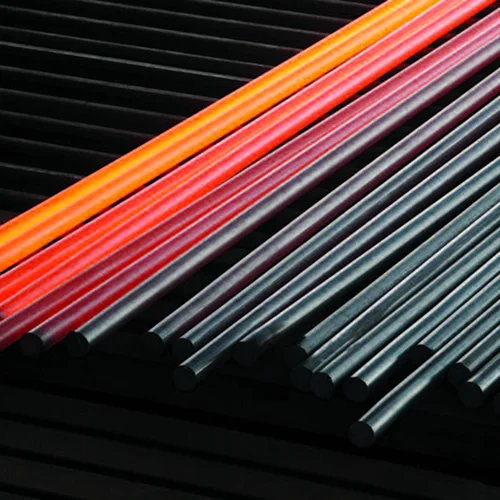
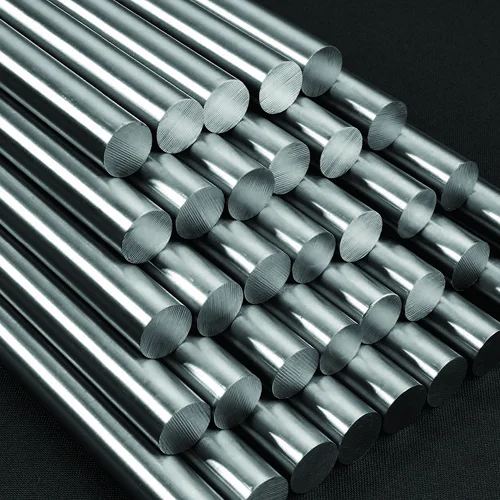
Laxcon Steels makes EN8, EN19 and EN24 to order as hot rolled round bar from 16 to 125 mm, and EN8 as bright bar from 5 to 115 mm. The stainless grades that EN56 to EN58 once named are rolled under their AISI numbers. Bar is supplied annealed, normalised, or hardened and tempered to a BS 970 condition, and the mill test certificate states the grade, the standard and the condition delivered.
Frequently asked questions
What does EN mean in EN8?
In EN8 the letters are part of a grade number from BS 970:1955, the British standard for wrought engineering steels. They do not refer to a European standard. The European standards that replaced BS 970, such as EN 10083, use EN for European Norm, and the nearest European grade to EN8 in them is C40.
What are the BS 970 codes for EN8, EN19 and EN24?
EN8 is 080M40, EN19 is 709M40 and EN24 is 817M40. In each code the M means the steel is ordered to mechanical properties, and the last two digits give the mean carbon content, 0.40 percent in all three.
What is the difference between EN19 and EN24?
EN24 contains 1.3 to 1.8 percent nickel on top of the chromium and molybdenum that EN19 carries. The nickel lets EN24 harden through larger sections and gives it more toughness at the same strength. EN19 is the usual choice for medium sections, and EN24 for heavy shafts and highly stressed parts.
What does the T in EN19T mean?
T is the BS 970 condition letter for a hardened and tempered bar with a tensile strength of 850 to 1,000 N/mm2. The letter is not part of the grade name. It holds only up to the limiting ruling section of the condition, beyond which the centre of the bar does not reach the specified strength.
Sources
- BS 970, the British standard for wrought engineering steels: the 1955 edition and its EN numbers, and later editions to 1991 with the six-character designations.
- EN 10027-1 and EN 10027-2, Designation systems for steels: steel names and steel numbers.
- EN 10083-2 and EN 10083-3, Steels for quenching and tempering; EN ISO 683-17, Ball and roller bearing steels.
- EN 10088-3, Stainless steels: semi-finished products, bars, rods, wire, sections and bright products.
- Stockholder datasheets for BS 970 steels, for the correspondence between EN numbers, six-character codes and condition letters.
- The grade compositions in the Laxcon grade reference.