Stainless Steel Channels: Taper, Section and Weight per Metre
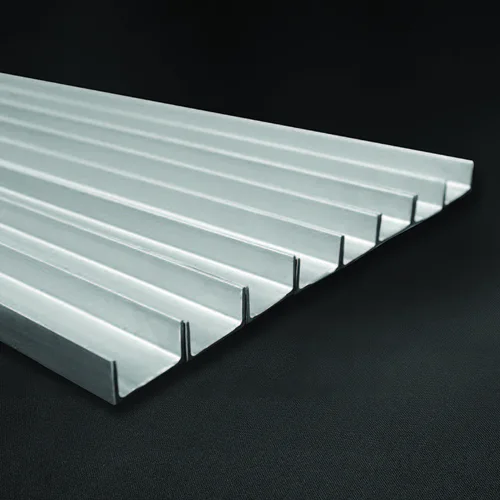
Send an enquiryStainless steel channel is an open rolled section formed of a web and two flanges that face the same way. It is produced in two flange forms: tapered, in which the flange thins from the web towards its tip, and parallel, in which the flange thickness is constant. The two forms differ in weight per metre, in how a bolted connection seats, and in how the section is dimensioned. This article describes the two forms, lists the sections rolled by Laxcon with calculated weights per metre, summarises the scope of the tolerance standard EN 10279, and sets out the information a channel order requires.
Tapered and parallel flange forms
The tapered flange channel is the older rolled form. The inside face of each flange slopes, so the flange is thick at the web and thin at the tip. The parallel flange channel has flanges of constant thickness.
| Tapered flange | Parallel flange | |
|---|---|---|
| Flange thickness | Varies from root to tip | Constant |
| Bolting | A tapered washer is needed for the bolt head to seat square | A plain washer seats flat |
| Section modulus for the same depth | Generally lower | Generally higher, because more metal is at the flange tip |
| Dimensional call-out | Depth, flange width, web thickness, flange thickness. Four numbers | Depth, flange width, thickness. Three numbers |
| Where it is specified | Legacy drawings, imperial-derived sections, general fabrication | Modern structural work, bolted connections |
The dimensional call-out distinguishes the two forms in practice. A tapered section is stated with four numbers, since the web and flange thicknesses differ; a parallel section is stated with three. An enquiry that does not state the form leaves the quotation ambiguous, because the same nominal size exists in both.
Rolled sections and weight per metre
All channels are supplied hot rolled, annealed and pickled, in lengths up to 6.4 metres, to EN 10279 tolerances, with deburred or plain ends. The weights below are calculated at a density of 7.90 g/cm3, the working figure used throughout the weight charts.
Parallel flange, non-tapered
| Section, depth x flange x thickness (mm) | Section area | Weight | Per 6.4 m length |
|---|---|---|---|
| 50 x 25 x 5 | 450 mm2 | 3.56 kg/m | 22.8 kg |
| 75 x 40 x 5 | 725 mm2 | 5.73 kg/m | 36.7 kg |
| 75 x 40 x 6 | 858 mm2 | 6.78 kg/m | 43.4 kg |
| 80 x 40 x 5 | 750 mm2 | 5.93 kg/m | 37.9 kg |
| 80 x 40 x 6 | 888 mm2 | 7.02 kg/m | 44.9 kg |
| 100 x 50 x 5 | 950 mm2 | 7.51 kg/m | 48.0 kg |
| 100 x 50 x 6 | 1,128 mm2 | 8.91 kg/m | 57.0 kg |
| 101.6 x 44.45 x 6.35 | 1,129 mm2 | 8.92 kg/m | 57.1 kg |
| 101.6 x 50.8 x 6.35 | 1,210 mm2 | 9.56 kg/m | 61.2 kg |
Tapered flange
| Section, depth x flange x web x flange thickness (mm) | Section area | Weight | Per 6.4 m length |
|---|---|---|---|
| 50 x 25 x 3 x 3.3 | 295 mm2 | 2.33 kg/m | 14.9 kg |
| 50 x 25 x 5 x 6 | 490 mm2 | 3.87 kg/m | 24.8 kg |
| 50 x 38 x 5 x 7 | 712 mm2 | 5.62 kg/m | 36.0 kg |
| 65 x 42 x 5.5 x 7.5 | 905 mm2 | 7.15 kg/m | 45.8 kg |
| 100 x 50 x 6 x 8.5 | 1,348 mm2 | 10.65 kg/m | 68.2 kg |
| 101.6 x 40.23 x 4.76 x 7.52 | 1,017 mm2 | 8.03 kg/m | 51.4 kg |
The effect of the flange form on weight is visible in the 100 x 50 size, which appears in both tables. The parallel channel at 6 mm thickness weighs 8.91 kg/m. The tapered channel at 6 mm web weighs 10.65 kg/m, nineteen percent more, because its flanges are 8.5 mm at the root. The same nominal size on a purchase order therefore corresponds to materially different tonnage and price depending on the form.
Calculation method
Each weight is the section area multiplied by the density and the length. For a parallel channel the section is treated as three rectangles: the web at depth times thickness, plus two flanges at flange width minus thickness, times thickness. For a tapered channel the web is taken between the flanges and each flange at its stated thickness.
The approximation ignores the fillet radii at the web-to-flange junctions and the taper on the flange tip. Fillets add metal, so the figures read slightly low against a rolled section, in the same way and for the same reason that the equal angle formula on the weight charts lands 1.3 to 2.8 percent below the published angle chart. The figures are suitable for costing and freight estimation; where the exact weight is contractual, the mill certificate is the reference.
Scope of EN 10279
EN 10279 is the tolerance standard under which the channels are supplied. It sets permitted deviation on the depth, the flange width, the web and flange thickness, the squareness of the flange to the web, the straightness along the length, and the cut length. It does not set the fillet radius, the surface condition or the mechanical properties.
Because the standard permits a deviation band rather than fixing a value, two compliant channels from two mills can differ in flange squareness by the full permitted band, which affects the fit of a bolted flange connection during fabrication. Where squareness is critical, it is stated on the order as an explicit requirement rather than assumed from the standard.
Grade selection
Grade selection for a channel follows the same corrosion criteria as for any structural stainless steel, determined by the service environment.
- 304 and 304 L for indoor structures, dry outdoor exposure away from the coast, and general fabrication. Chromium 18.0 to 20.0 percent, PREN band 18.0 to 21.6.
- 316 and 316 L for coastal, marine, de-icing salt, swimming pool and chloride-bearing process environments. Molybdenum 2.0 to 3.0 percent raises the PREN band to 22.6 to 29.5.
- The L variants wherever the section will be welded and then exposed, because carbon above roughly 0.03 percent can sensitise the heat-affected zone.
- A lean duplex such as S 32101 where the structure is priced on tonnage. Roughly double the proof stress at 1.35 to 1.70 percent nickel allows a lighter section to carry the same load.
Fuller treatment of the underlying grade properties is given in the 304 guide and the PREN reference.
Information required in an order
- Tapered or parallel. The most common omission, and the one that changes the weight by nearly twenty percent.
- The full section call-out. Four numbers for a tapered section, three for a parallel one.
- Grade and standard. Determined by the environment.
- Length, and whether it is cut to length. Published up to 6.4 metres.
- End condition and marking. Deburred or plain ends. Inkjet marking by grade and size is available, and the dispatch mark carries the heat number, grade, size and bundle weight.
Frequently asked questions
What is the difference between a C channel and a U channel?
C channel and U channel are trade names for the same product: an open section with a web and two flanges facing the same way. C is the more common name in India and U in European practice. The variation that matters between suppliers is whether the flanges are tapered or parallel, not the letter.
What sizes of stainless channel do you supply?
Laxcon supplies stainless steel channel from 50 x 25 mm through 101.6 x 50.8 mm, in both tapered and parallel forms, in lengths up to 6.4 metres. The full list with dimensions is on the channels product page. Sections outside the published list are handled by enquiry.
How do I calculate stainless channel weight?
Stainless channel weight is calculated by breaking the section into three rectangles, adding the areas, and multiplying by 0.0079 to obtain kilograms per metre at 7.90 g/cm3. Every published section is already calculated in the tables above. For grade-specific accuracy, 304 is closer to 7.93 g/cm3 and 316 to 7.98, corresponding to additions of roughly 0.4 and 1.0 percent respectively.
Is stainless channel stronger than mild steel channel?
Stainless channel is not automatically stronger than mild steel channel. An annealed austenitic grade is comparable to mild steel in yield strength. Its advantage is that it does not need painting or galvanising and does not lose section to corrosion over decades. A duplex grade is genuinely stronger, at roughly double the proof stress.
Can you supply channels cut to length?
Channels are supplied cut to length. Cutting to size is offered against the published range, and end condition can be deburred or plain.
What surface condition do the channels arrive in?
Channels are supplied HRAP: hot rolled, solution annealed and pickled. Pickling removes the mill scale. Scale is not the passive film, and a scaled surface will not passivate.
Sources
Section sizes, supply condition, tolerance standard, length and end finish are the published supply conditions on the channels product page. Weights on this page are calculated from those published dimensions at 7.90 g/cm3 using the three-rectangle method described above, in line with the coefficients on the weight charts. Composition windows and PREN bands are from the grade reference and the PREN reference. The description of EN 10279 states the scope of the standard rather than a Laxcon measurement.