Free-Machining Stainless Steel: 303, 416, 420F and ASTM A582
Send an enquiryFree-machining stainless steel is stainless steel to which sulphur or selenium has been added so that it cuts with short, broken chips, lower tool wear and a better surface than the standard grade it is based on. The addition forms non-metallic inclusions, chiefly manganese sulphide, that break the chip and lubricate the tool. The common free-machining grades are 303, the free-machining form of the austenitic 304; 416, the free-machining form of the martensitic 410; 420F, a higher-carbon hardenable grade; and 430F, the free-machining ferritic grade. In North America they are supplied as bar under ASTM A582; in Europe the corresponding free-cutting steels, such as 1.4305 and 1.4005, are listed in EN 10088-3. The same inclusions that ease machining lower corrosion resistance, weldability, formability and transverse toughness, so each free-machining grade is a trade between cycle time on the lathe and performance in service.
How sulphur makes stainless steel machinable
Standard austenitic stainless steel is difficult to machine for three reasons. It work hardens quickly, so the layer ahead of the tool becomes harder than the bar. It is tough and ductile, so the chip forms as a long, continuous ribbon that tangles round the tool and the work. Its low thermal conductivity makes the cutting edge run hot. The free-machining grades address the second of these directly and the others indirectly.
A sulphur content of 0.15 percent or more combines with manganese to form manganese sulphide inclusions, which rolling stretches into stringers along the bar. Under the cutting edge each inclusion acts as an internal notch: the chip shears through the inclusions and breaks into short pieces instead of a ribbon. The sulphide also smears across the tool face as a solid lubricant, which lowers the cutting force and the built-up edge and so improves tool life and surface finish. Selenium, added at 0.15 percent or more in the Se grades, forms selenide inclusions with a similar effect; 303Se machines slightly more slowly than 303 but gives a better machined finish and better hot and cold forming. Some grades also raise the manganese, which combines with the sulphur: XM-5 (S30310) carries 2.5 to 4.5 percent manganese with at least 0.25 percent sulphur, and XM-6 (S41610) 1.5 to 2.5 percent manganese with at least 0.15 percent sulphur.
The standard grades carry far less sulphur. AISI 304 and 316 are limited to 0.030 percent maximum. EN 10088-3 permits a controlled sulphur content of 0.015 to 0.030 percent in its standard austenitic grades for machinability. That level improves chip breaking with a far smaller loss of corrosion resistance than a free-machining grade suffers.
The free-machining grades by family
| Grade | UNS | Family | Free-machining form of | Addition, percent | Hardenable | Nearest EN |
|---|---|---|---|---|---|---|
| 303 | S30300 | Austenitic | 304 | S 0.15 min | No | 1.4305 |
| 303Se | S30323 | Austenitic | 304 | Se 0.15 min | No | None listed |
| XM-5 | S30310 | Austenitic | 304 | S 0.25 min, Mn 2.5 to 4.5 | No | None listed |
| 416 | S41600 | Martensitic | 410 | S 0.15 min | Yes | 1.4005 |
| 416Se | S41623 | Martensitic | 410 | Se 0.15 min | Yes | None listed |
| XM-6 | S41610 | Martensitic | 410 | S 0.15 min, Mn 1.5 to 2.5 | Yes | None listed |
| 420F | S42020 | Martensitic | 420 | S 0.15 min, C 0.30 to 0.40 | Yes | 1.4029 (nearest) |
| 430F | S43020 | Ferritic | 430 | S 0.15 min | No | 1.4104 (nearest) |
Compositions are those of the Laxcon Steels grade reference; the EN numbers are the nearest counterparts, not identities, and the steel names show how they differ. 1.4305 is X8CrNiS18-9 and 1.4005 is X12CrS13. 1.4029, X29CrS13, is a 13 percent chromium free-cutting steel at about 0.29 percent carbon. 1.4104, X14CrMoS17, adds molybdenum to a 17 percent chromium free-cutting base.
303 against 304 and 316
AISI 303 is 304 with the sulphur raised from 0.030 percent maximum to 0.15 percent minimum, the phosphorus limit raised from 0.045 to 0.20 percent, and the carbon limit raised from 0.08 to 0.15 percent. Its chromium and nickel are close to those of 304: 17.0 to 19.0 percent chromium and 8.0 to 10.0 percent nickel, against 18.0 to 20.0 and 8.0 to 10.5. Like 304 it is austenitic and non-magnetic when annealed, and it cannot be hardened by heat treatment.
The difference in service follows from the inclusions. The pitting resistance equivalent number of 303 is 17.0 to 19.0 at its specified limits, against 18.0 to 21.6 for 304 and 22.6 to 29.5 for 316, but the number understates the gap, because each sulphide inclusion is a site where a pit can start and the calculation does not account for them. A cut end exposes the stringers end-on, which makes the machined faces of a 303 part its weakest surfaces. 303 is therefore used for parts in dry or mildly corrosive service, such as fittings, bushes, shafts, valve parts and instrument components, and is avoided in seawater, coastal air and chloride process streams. Weldability and formability are also lower than those of 304, because the sulphides promote hot cracking in the weld and reduce ductility in a bend.
None of the common free-machining grades carries the 2.0 to 3.0 percent molybdenum of 316. Where a turned part needs the chloride resistance of molybdenum, 316 itself is machined, more slowly, or a 316 is melted to the controlled sulphur range that EN 10088-3 permits for its standard austenitic grades. The grades are compared in general service in 304 vs 316 stainless steel.
416 and 420F against 410 and 420
AISI 416 is 410 with at least 0.15 percent sulphur and a manganese limit raised to 1.25 percent. It hardens by austenitising, quenching and tempering, as 410 does, which allows a part to be machined in the soft condition on an automatic lathe and then hardened. No austenitic grade offers that combination. 416 ranks at or near the top of the published machinability ratings for stainless steel. Its corrosion resistance is below that of 410 and well below that of the austenitic grades: it serves in dry air, fresh water and mild chemicals, and is not used in chloride service. Like all martensitic grades it is magnetic in every condition, which suits it to solenoid and magnetic-circuit parts as well as to valve parts, pump shafts and screw-machined components.
AISI 420F raises the carbon to 0.30 to 0.40 percent, against a 0.15 percent minimum for 420, so that it hardens to a higher level than 416. It is used where a machined part must also resist wear, at the cost of lower toughness. Tempering of 416 between about 400 and 580 degrees Celsius is avoided, because toughness is poor in that range. In both grades the sulphide stringers lower the transverse ductility and impact energy, so a part loaded across the bar axis is weaker than the same part loaded along it.
ASTM A582 and the EN free-cutting grades
ASTM A582/A582M is the specification for free-machining stainless steel bar. It covers hot-finished and cold-finished rounds, squares and hexagons in the free-machining stainless steels, designed for machining and for general corrosion and high-temperature service. Bars for reforging are excluded and fall under ASTM A314, and stainless bars of the standard, non-free-machining grades fall under ASTM A276. The general requirements for dimensions, straightness and testing come from ASTM A484, which A582 shares with A276; wire and wire rod in the free-machining grades are specified separately under ASTM A581.
A582 specifies the condition of the bar and a hardness, not a tensile strength. Condition A is annealed and carries a maximum hardness of 262 HB for the common grades. 416 and its variants may also be ordered in Condition T, an intermediate temper of 248 to 302 HB, or in Condition H, a hard temper. A582 lists 303 in Condition A only, because an austenitic grade cannot be hardened by heat treatment. A guaranteed tensile or proof strength is therefore not part of an A582 order unless it is added as a supplementary requirement. Typical annealed values for 303 and 416 are given on the AISI 303 and AISI 416 grade pages.
In Europe the free-cutting stainless steels for bars, rods and sections are listed in EN 10088-3 among its austenitic, martensitic and ferritic grades, identified by the S in the steel name: X8CrNiS18-9 (1.4305), X12CrS13 (1.4005), X29CrS13 (1.4029) and X14CrMoS17 (1.4104). The sulphur range for 1.4305 and 1.4005 is 0.15 to 0.35 percent, an upper limit that the ASTM grades, specified by a minimum only, do not state.
Machinability ratings
A machinability rating compares the cutting speed at which a steel gives a set tool life with the speed for a reference steel rated 100. The rating depends on the reference steel, the tool, the operation and the test, so figures from different sources are not comparable. The table gives one internally consistent set, from the United States Air Force technical order on aerospace metals, which rates each stainless grade against free-machining screw stock AISI B1112.
| Grade | Family | Rating, percent of B1112 |
|---|---|---|
| 430F | Ferritic, free-machining | 80 |
| 416 | Martensitic, free-machining | 75 |
| 420F | Martensitic, free-machining | 70 |
| 303 | Austenitic, free-machining | 65 |
| 410 | Martensitic | 50 |
| 430 | Ferritic | 50 |
| 420 | Martensitic | 45 |
| 304 | Austenitic | 40 |
| 316 | Austenitic | 40 |
Other sources give different numbers. Atlas Steels, for example, rates 303 at about 78 percent and 416 at about 85 percent of free-cutting carbon steel B1212. The two sources agree on the order: 416 cuts faster than 303, and both cut far faster than 304 and 316. In the table each free-machining grade rates 25 to 30 points above its base grade. A rating ranks grades for a high-volume turned part; it does not set the cutting speed for any one machine.
Service limits of the free-machining grades
Each free-machining grade is unsuitable for some duties that its base grade performs. The limits follow from the inclusions and apply to every grade in the family:
- Chlorides. Seawater, brine, coastal air, chlorinated water and salt spray start pits at the sulphide inclusions, and polishing or passivation does not remove them. The base grade, or 316 for the austenitic family, is used instead.
- Welding. Sulphur promotes solidification cracking in the weld metal and the heat-affected zone. A part that is to be welded is made from the base grade.
- Forming. Cold heading, sharp bending and deep drawing are limited by the lower ductility, especially across the rolling direction.
- Transverse loading. The inclusions are aligned along the bar, so ductility and toughness across the bar are lower than along it.
The general behaviour of stainless steels in corrosive service is set out in corrosion of stainless steel.
Free-machining grades in Laxcon bar
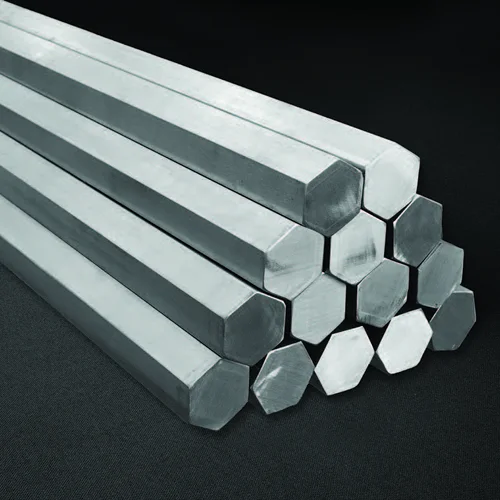
Stainless steel hexagonal bright bar is drawn by Laxcon Steels from 15 mm to 52 mm across flats, in lengths up to 6 metres, to h11, k12, k13 or ASTM A484 tolerances. A hexagon is the starting form for nuts, hose ends and valve spindles because the flats need no milling, and 303 under ASTM A582 is the usual hexagon grade for high-volume turned parts, with 304 and 316 used where the finished part is welded or sees corrosive service. AISI 303 and AISI 416 are also listed as 303 hot rolled round bar, 416 hot rolled round bar and 303 HRAP flat bar. The tolerance classes of drawn hexagon bar are explained in tolerance classes for stainless steel bar.
Frequently asked questions
What is the difference between 303 and 304 stainless steel?
303 is 304 with at least 0.15 percent sulphur added, which forms manganese sulphide inclusions that break the chip and lubricate the tool. 303 machines much faster than 304, but it has lower corrosion resistance, especially in chlorides, and it is poor for welding and forming. 304 is used where a part is welded, formed or exposed to corrosive service.
What is the easiest stainless steel to machine?
The free-machining ferritic and martensitic grades, 430F and 416, rank highest in the published machinability ratings, followed by 420F and the austenitic 303. Among the standard grades, 304 and 316 are among the hardest to machine because they work harden and form long chips.
Can 303 stainless steel be welded?
Welding of 303 is not generally recommended. Its sulphur promotes hot cracking in the weld metal and the heat-affected zone, and the weld retains lower mechanical and corrosion properties than a weld in 304. A part that must be welded is made from 304 or 304L.
What does ASTM A582 cover?
ASTM A582 covers hot-finished and cold-finished bars of the free-machining stainless steels, in rounds, squares and hexagons, including 303, 416, 420F and 430F and their selenium and high-manganese variants. It specifies the condition and hardness of the bar rather than its tensile strength. Standard grades such as 304 and 316 are covered by ASTM A276 instead.
Is 416 stainless steel magnetic?
Yes. AISI 416 is a martensitic stainless steel and is ferromagnetic in every condition, annealed or hardened. The free-machining austenitic grade 303, like 304, is non-magnetic when annealed.
Sources
- ASTM A582/A582M-22, Standard Specification for Free-Machining Stainless Steel Bars.
- ASTM A276/A276M, Standard Specification for Stainless Steel Bars and Shapes.
- ASTM A484/A484M, Standard Specification for General Requirements for Stainless Steel Bars, Billets, Shapes, and Forgings.
- ASTM A581/A581M, Standard Specification for Free-Machining Stainless Steel Wire and Wire Rods.
- EN 10088-3, Stainless steels, Part 3: Technical delivery conditions for semi-finished products, bars, rods, wire, sections and bright products of corrosion resisting steels for general purposes.
- T.O. 1-1A-9, Aerospace Metals, General Data and Usage Factors, United States Air Force: Table 2-7, machining comparison of corrosion resisting steel to free-machining screw stock B1112.
- Atlas Steels, grade data sheets for 303 and 416: machinability relative to B1212.