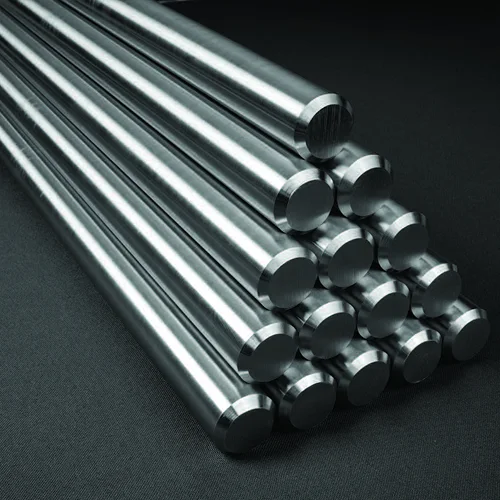
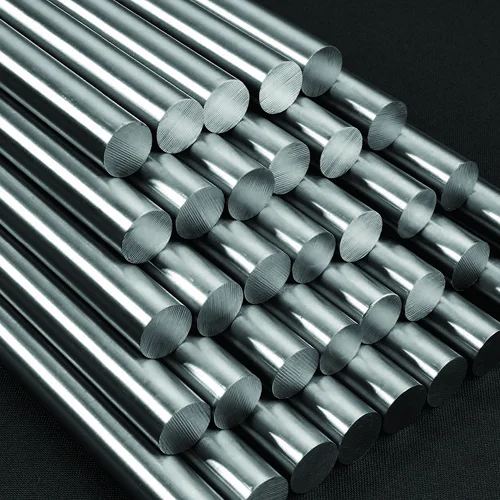
Stainless Steel Shafts: Grade Selection by Service Condition
Send an enquiryA stainless steel shaft is a rotating machine component that transmits torque while resisting corrosion in its operating environment. A shaft in service must carry torque, withstand millions of load reversals, hold a dimensional tolerance at bearing and seal surfaces, and resist corrosion from the surrounding medium. No single stainless grade performs best in all four respects, so grade selection proceeds from the duty of the shaft. The composition windows cited in this article are those published in the Laxcon grade register. The supply condition of the bar is a separate decision from the grade, and is treated in the article on precision shaft quality bars.
Failure modes of shafts
Grade selection depends on which failure mechanism the design must resist. Five mechanisms account for most shaft failures.
- Fatigue. Most rotating shafts that break do so in fatigue. Fatigue cracks initiate at surface features: a machining mark, a sharp keyway corner, a shoulder without a fillet, or a corrosion pit. Surface finish and geometry therefore influence fatigue life more than the grade does, which is why surface roughness appears in bar specifications.
- Corrosion fatigue. A corrosion pit acts as a stress raiser. In wet service the two mechanisms compound, and a grade with adequate corrosion resistance outlasts a stronger grade without it.
- Wear and galling. These occur where the shaft runs against a bush, a seal, or another stainless part. Austenitic grades gall severely against each other; hardened martensitic surfaces do not.
- Deflection. Deflection is governed by shaft diameter and length, not by the grade, because all steels have effectively the same elastic modulus. Specifying a higher-strength grade does not reduce deflection; increasing the diameter does.
- Runout at assembly. Runout is a question of straightness and tolerance, which the supply condition of the bar addresses.
Grade selection by duty
| Duty | Grade | Key composition | Why it is the answer |
|---|---|---|---|
| Clean water, food, dairy, general machinery. Austenitic family | 304 and 304 L | Cr 18.0 to 20.0, Ni 8.0 to 10.5 | Adequate corrosion resistance, weldable, cheapest austenitic. Order L if it will be welded and stay wet |
| Chlorides, coastal air, chemical process | 316 and 316 L | Cr 16.0 to 18.0, Ni 10.0 to 14.0, Mo 2.0 to 3.0 | Molybdenum repairs the passive film where chloride breaks it. PREN band 22.6 to 29.5 against 18.0 to 21.6 |
| Higher strength without more nickel | 304 N | as 304 with N 0.10 to 0.16 | Nitrogen strengthening, same corrosion family |
| Load and wear, mild corrosion | 431 | Cr 15.0 to 17.0, Ni 1.25 to 2.50, C max 0.20 | The classic shaft martensitic. Hardenable, and the nickel keeps toughness that 410 and 420 give away |
| Wear surfaces, valve stems, light corrosion | 420 and 410 | Cr 12.0 to 14.0 and 11.5 to 13.5 | Hardenable, cheap, and at the bottom of the chromium range. Do not use them in salt |
| Pump and turbine shafts, tough and weldable | F-6NM and 1.4418 | C max 0.05, Cr 11.5 to 14.0, Ni 3.5 to 5.5, Mo 0.5 to 1.0; and Cr 15.0 to 17.0, Ni 4.0 to 6.0, Mo 0.8 to 1.5 | Soft martensitic. Very low carbon, so it hardens without the brittleness and welds far better than 420 |
| High strength with corrosion resistance, machined complex | 17/4 PH and 15/5 PH | Cr 15.0 to 17.5, Ni 3.0 to 5.0, Cu 3.0 to 5.0 | Machined in the solution treated condition, then aged at low temperature with almost no distortion |
| Seawater, high chloride, high load | 2205 and 2507 | Cr 22.0 to 23.0, Mo 3.0 to 3.5, N 0.14 to 0.20; and Cr 24.0 to 26.0, Mo 3.0 to 5.0 | Roughly double the proof stress with chloride resistance well above 316 |
| High volume machining, dry duty | 303 and XM 6 | sulphur raised to 0.15 percent | Free machining. The sulphide inclusions that break the chip are also corrosion initiation sites and they ruin weldability |
Soft martensitic grades
F-6NM and 1.4418 are soft martensitic grades that occupy a position between the traditional martensitic and austenitic options. A conventional martensitic shaft grade contains 0.15 to 0.20 percent carbon and is hardened and tempered; it is strong and hard, but it welds poorly, is notch sensitive, and pits in chloride-bearing environments. An austenitic grade resists corrosion but remains soft.
F-6NM limits carbon to 0.05 percent maximum and replaces the hardening contribution of carbon with 3.5 to 5.5 percent nickel and 0.5 to 1.0 percent molybdenum. 1.4418 contains 15.0 to 17.0 percent chromium, 4.0 to 6.0 percent nickel and 0.8 to 1.5 percent molybdenum, with carbon at 0.06 percent maximum. Both grades harden through section, retain impact toughness, weld without the precautions required for conventional martensitic grades, and carry sufficient chromium and molybdenum for service in water. They are the standard material for pump and turbine shafts and are routine grades to specify.
Galling
Austenitic stainless steels gall when slid against each other under load. Two 316 parts in sliding contact cold weld at the contact points, tear, and seize. This mechanism is the reason a stainless fastener seizes in a stainless nut, and the reason an austenitic shaft running in an austenitic bush is a poor design regardless of the corrosion resistance of either part.
The remedy is dissimilar hardness at the contact. A hardened martensitic or precipitation hardening shaft can run against a softer bush, a hard-coated surface, or a non-metallic bearing. Where the shaft must be austenitic for corrosion reasons, the mating part should not be.
Supply conditions
Once the grade is selected, the bar is ordered in one of four supply conditions, distinguished by diameter range, tolerance, surface, and testing.
| Product | Diameter | What you are buying |
|---|---|---|
| Precision shaft quality bar | 8 mm to 81 mm | h7, h8, h9, j6, f7 or f8, straightness 0.015 inch TIR per 10 feet, checked for ultrasonic flaws, distance ring packed |
| Bright bar | 5 mm to 115 mm | h7 to h11, k12, k13, Ra 0.2 micron, straightness up to 0.5 mm per metre |
| Hot rolled round bar | 16 mm to 125 mm | Black or ground, 100 percent ultrasonically tested, for shafts that will be fully machined |
| Proof machined bar | 120 mm to 550 mm | Rough turned below the skin so the surface is proven clean before final machining. Ultrasonically tested |
For large shafts, above 115 mm, the cold finishing range ends and the product becomes a proof machined bar. In this condition the defect-prone outer skin of the bar has already been removed and inspected before the bar is supplied, rather than being discovered during final machining.
Contents of a shaft enquiry
A complete shaft enquiry specifies six items.
- Grade and standard. Selected from the duty, and named against one standard.
- Delivery condition. Annealed, quenched and tempered, or solution treated for later ageing. On a martensitic or precipitation hardening grade the delivery condition constitutes the entire mechanical specification.
- Diameter and tolerance class. An h, j or f class with its grade number. Fit tables are given in the PSQ guide.
- Straightness, where critical. Otherwise the published figure for the product applies.
- Testing. Ultrasonic testing is published as standard on hot rolled round bar and proof machined bar. Eddy current testing on cold finished bar is to requirement.
- Weight, where pricing is required. The diameter in millimetres squared, multiplied by 0.006205, gives kilograms per metre at a density of 7.90 g/cm3. The full table is on the weight charts.
Frequently asked questions
What is the best material for a motor shaft?
For a dry, enclosed motor the corrosion requirement is low, and a hardenable martensitic grade such as 431 provides strength and wear resistance economically. Where the motor is washed down, or operates in food or marine service, the selection moves to 316 or to a soft martensitic grade such as 1.4418, which retains strength without loss of corrosion resistance.
What is the best material for a pump shaft?
The soft martensitic grades F-6NM and 1.4418 are the standard selection for water and general process pumps. In seawater or high-chloride duty the selection moves to a duplex grade, and in aggressive chemical service to 17/4 PH or a higher-alloy austenitic grade, depending on the fluid.
Is 304 strong enough for a shaft?
Grade 304 is strong enough for shafts in light and moderate duty in clean conditions, and it is widely used for them. It is soft compared with a hardened grade, it galls against other austenitic parts, and it will not take a hardened bearing seat. Where the shaft is heavily loaded or runs against another part, a hardenable grade is the better selection.
Can a stainless shaft be hardened?
A stainless shaft can be hardened by heat treatment only if it is a martensitic or a precipitation hardening grade. The austenitic family cannot be hardened by heat treatment, only by cold work. This structural property decides the grade family before any other consideration.
What diameter tolerance does a bearing seat need?
A bearing seat requires a transition fit, which in the published range is j6, unless the bearing manufacturer specifies otherwise for the load and speed. A clearance class such as f7 allows the inner race to creep on the shaft.
Do you supply shafts machined to a drawing?
Laxcon supplies bar rather than machined shafts. The properties under the supplier's control are the grade, the delivery condition, the diameter tolerance, the straightness and the surface, which together determine how much machining remains. A drawing sent with an enquiry allows the product that leaves the least work to be identified.
Sources
Every composition window in this article is the published specification in the Laxcon grade reference. Size ranges, tolerance classes, straightness, surface finish, testing and packing are the published supply conditions on the PSQ, bright bar, hot rolled round bar and proof machined bar pages. PREN bands are calculated in the Laxcon PREN reference. Weight coefficients are on the weight charts. Statements on fatigue, galling and stiffness behaviour are general engineering knowledge rather than Laxcon measurements.