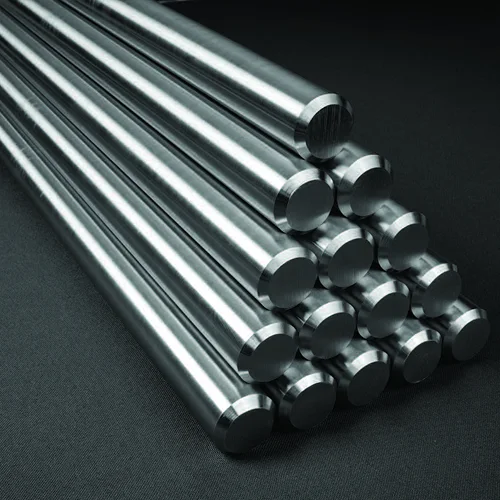
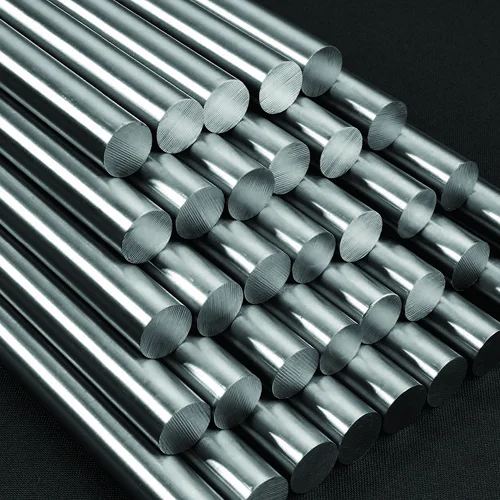
PSQ Bars: The Precision Shaft Quality Supply Condition
Send an enquiryPrecision shaft quality (PSQ) is a supply condition for stainless steel bar, defined by controls on diameter tolerance, straightness, surface and internal soundness. It is not a grade and not a product family: a PSQ bar and a bright bar can be produced from the same steel of the same heat, and differ only in the conditions controlled at manufacture. The condition exists because rotating parts have different failure modes from static ones. A bar deviation of 0.2 mm has no consequence in a static bracket, but in a pump shaft it produces vibration, additional bearing load and seal leakage. PSQ bars are specified for parts where the bar surface and geometry serve directly in rotation.
Comparison with bright bar
The published supply conditions for the two products differ as follows.
| Published condition | Bright bar | PSQ bar |
|---|---|---|
| Size range | 5 mm to 115 mm | 8 mm to 81 mm |
| Length | up to 6.5 m | up to 6.4 m |
| Tolerance classes | h7, h8, h9, h10, h11, k12, k13, ASTM A484 | h7, h8, h9, j6, f7, f8 |
| Straightness | up to 0.5 mm per metre | 0.015 inch TIR per 10 feet |
| Internal soundness | eddy current to requirement | checked for ultrasonic flaws, eddy current to requirement |
| Packing | bundles with two lifting slings | distance rings, then plywood boxes |
The straightness and tolerance rows carry the principal distinctions.
Straightness
The PSQ straightness figure of 0.015 inch total indicator reading per 10 feet equals 0.381 mm over 3.048 metres, or 0.125 mm per metre. The bright bar figure is up to 0.5 mm per metre. The PSQ specification is therefore four times straighter in the as-supplied condition. Straightness governs the behaviour of a bar in a bar feeder, on a steady rest and in a bearing: a bar with runout whips at speed, and whip limits the spindle speed at which the part can be machined.
Tolerance classes
Bright bar is offered in h and k classes. PSQ adds j6, f7 and f8. The letters describe fits between a shaft and a bore rather than sizes alone. The fits named below are the hole-basis ones, that is, the result of running each shaft class against a bore held to H7; a different bore class gives a different fit from the same bar.
| Class | Where the band sits | The fit it produces |
|---|---|---|
| h7, h8, h9 | Upper deviation zero. Bar is at or below nominal | Locational. The reference class for a shaft that a bore is designed around |
| j6 | Straddles nominal, slightly more above than below | Transition. A snug locational fit, assembled with light force, for bearing seats and coupling hubs |
| f7 | Displaced below nominal by a defined clearance | Running fit. Deliberate clearance for a shaft turning in a plain bearing with lubrication |
| f8 | Same displacement, wider band | Running fit where the clearance can be looser and the bar cheaper |
At a nominal diameter of 40 mm, the ISO 286 deviation values give the following permitted diameters.
| Class | Deviations | Actual diameter permitted |
|---|---|---|
| 40 h7 | 0 to -25 micron | 40.000 to 39.975 mm |
| 40 j6 | +11 to -5 micron | 40.011 to 39.995 mm |
| 40 f7 | -25 to -50 micron | 39.975 to 39.950 mm |
| 40 f8 | -25 to -64 micron | 39.975 to 39.936 mm |
A j6 shaft and an f7 shaft at the same nominal size differ by up to 75 microns; the former produces a light interference and the latter a running clearance. An order for 40 mm PSQ bar without a tolerance class therefore does not identify one of four distinct products.
Applications
The published applications of PSQ bar are rotating components: pump shafts, cylinder shafts, boat shafts, piston shafts, valve shafts and bearing bars. In these components the bar surface serves as a functional surface, running against a seal, a bush or a bearing, rather than being machined away.
Two published strength positions apply. The general PSQ range meets a tensile and yield requirement of 75 ksi. For higher strength, 304 shafting is offered at 100 ksi. The delivery condition recorded on the certificate is soft annealed, solution annealed, or quenched and tempered. Austenitic grades such as 304 have no martensitic transformation and cannot be hardened by heat treatment, so the higher position is reached by cold work in the drawing and finishing route rather than by a heat treatment condition.
Grade selection
Grade selection is a decision separate from the supply condition: the grade must be suitable for the service fluid and the load. The Laxcon grade register carries 547 grades, of which the shaft-relevant grades cluster in the families below.
| Duty | Grades to look at | Why |
|---|---|---|
| General service, clean water, food and dairy | 304, 304 L | Adequate corrosion resistance, easy to weld, lowest cost of the austenitics |
| Chlorides, coastal, chemical | 316, 316 L | 2.0 to 3.0 percent molybdenum, PREN band 22.6 to 29.5 against 18.0 to 21.6 for 304 |
| Load and wear, mildly corrosive | 431, 420 | Martensitic, hardenable by quench and temper. 431 keeps 15.0 to 17.0 percent chromium with 1.25 to 2.50 nickel for toughness |
| High strength with corrosion resistance | 17/4 PH, 15/5 PH | Machined soft, then aged with almost no distortion. See the PH guide |
| Seawater, high chloride, high strength | 2205, 2507 | Roughly double the proof stress and a PREN band well above 316. See the duplex guide |
A common specification error is to select a martensitic grade for its hardness and then place it in salt water. Hardness and corrosion resistance are governed by different alloying elements: grade 420, at 12.0 to 14.0 percent chromium and with no molybdenum, will pit in conditions where 316 does not.
Packing
PSQ bars are packed with distance rings and then boxed in plywood, rather than strapped into a bundle. Bars strapped tightly against each other rub in transit, and a scored surface on a shaft becomes a leak path at the seal. Distance rings hold the bars apart so that the surface finished at the plant is the surface delivered. Bundles are marked with heat number, grade, size and both net and gross weight, which preserves the connection between each bar and its test certificate after the packing is removed.
Specification of an order
A complete PSQ order states the following items.
- Grade and standard. Determined by the service fluid and the load, not by the tolerance.
- Diameter and tolerance class. h7, h8, h9, j6, f7 or f8. The class must be stated, because the classes produce different fits.
- Delivery condition. Soft annealed, solution annealed, or quenched and tempered. The delivery condition sets the mechanical properties on the certificate.
- Length, and whether cut lengths are required. Published lengths run up to 6.4 metres.
- Testing. Eddy current testing is to requirement and must be stated on the order to appear on the certificate.
Frequently asked questions
What does PSQ stand for?
PSQ stands for precision shaft quality, sometimes written pump shaft quality after the application with which it is most associated. It describes a supply condition covering diameter tolerance, straightness, surface and internal soundness.
Is PSQ bar just a ground bright bar?
A PSQ bar is not equivalent to a ground bright bar. The tolerance classes overlap, but PSQ adds a straightness commitment four times tighter than the bright bar figure, a check for ultrasonic flaws, and distance-ring packing that protects the finished surface. The distinguishing controls are straightness and soundness rather than diameter alone.
What sizes are available?
Precision shaft quality bars are supplied from 8 mm to 81 mm diameter, in lengths up to 6.4 metres. Below 8 mm and above 81 mm the product supplied is a bright bar, at 5 mm to 115 mm, with the bright bar straightness figure.
Which tolerance class suits a bearing seat?
A bearing seat takes a transition class, which is j6 in this range, unless the bearing manufacturer specifies otherwise for the load and speed. A clearance class such as f7 allows the inner race to turn on the shaft, which damages both components.
What is TIR?
TIR is total indicator reading: the full sweep of a dial gauge as the bar is rotated, which measures runout rather than deflection in one direction. The published figure for PSQ bar is 0.015 inch per 10 feet, equal to 0.125 mm per metre.
Can I get PSQ bars in duplex or in a PH grade?
PSQ bars are available in duplex and in the precipitation hardening grades, because the finishing route is independent of the grade. Machinability, and therefore cost, differs: duplex and the precipitation hardening grades machine at lower speeds and wear tooling faster than 304.
Sources
Size range, length, tolerance classes, straightness, heat treatments, testing, packing and the 75 ksi and 100 ksi strength positions are the published supply conditions on the precision shaft quality bars page. Bright bar figures are from the bright bars page. Composition windows are in the grade reference; PREN bands are calculated in the PREN reference. Tolerance deviations in microns are ISO 286 standard values, published reference data rather than Laxcon measurements. The straightness conversion is arithmetic: 0.015 inch is 0.381 mm and 10 feet is 3.048 metres.