Stainless Steel Angles
Stainless steel equal and unequal angles, hot rolled, annealed and pickled, in lengths up to 6.4 metres
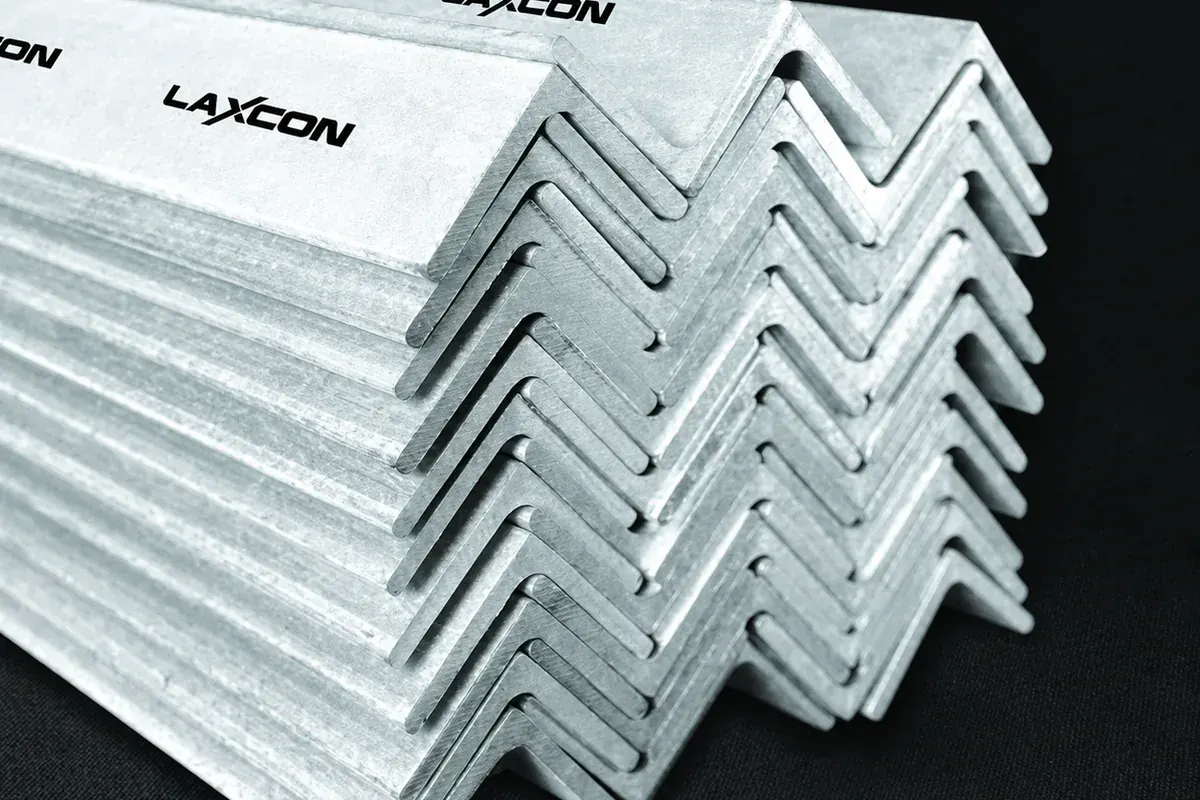
Product Description
Stainless steel angle is a hot rolled section of two legs at a right angle, ordered by its leg lengths and its thickness. Laxcon Steels rolls angles in two forms: equal angles from 20 × 20 mm to 127 × 127 mm in thicknesses of 3 mm to 15 mm, and unequal angles from 25 × 15 mm to 100 × 75 mm in thicknesses of 3 mm to 10 mm.
Both forms are supplied hot rolled, annealed and pickled (HRAP), to ASTM A484 or EN 10056 tolerances, in lengths up to 6.4 metres. Ends are deburred, or plain without burrs or sharp edges. Grit polishing and shot blasting are available on request.
Weight per metre for each leg size and thickness is in the equal angle weight chart, and the weight calculator takes the two leg lengths and the thickness.
Angle Specifications
- Size range
- 20 × 20 mm to 127 × 127 mm equal; 25 × 15 mm to 100 × 75 mm unequal
- Length
- Up to 6.4 metres
- Tolerance
- ASTM A484, EN 10056
- Supply condition
- Hot rolled, Annealed & Pickled (HRAP)
- Grit polish
- On request
- Bar ends
- Deburred Ends, Plain Ends without Burrs or Sharp Edges
- Standards
- ASTM A276, A484; EN 10088-3, EN 10056-1 and 10056-2
- Contamination
- Free from radioactive elements, mercury and lead
- Testing
- PMI grade check with handheld spectrometers
- Shot blasting
- On request
- Marking
- Inkjet printed with grade and size
- Weight per metre
- Metal weight calculator
- Production
- Made to order in every grade listed on this page
- Certifications
- DNV Approval of Manufacturer, CE Marking
Available Sizes
Size Range by Form
| Form | Size range | Length | Tolerance | Thickness |
|---|---|---|---|---|
| HRAP Equal Angles | 20 × 20 mm to 127 × 127 mm | Up to 6.4 m | ASTM A484, EN 10056 | 3 mm to 15 mm |
| HRAP Unequal Angles | 25 × 15 mm to 100 × 75 mm | Up to 6.4 m | ASTM A484, EN 10056 | 3 mm to 10 mm |
Angle
Forms
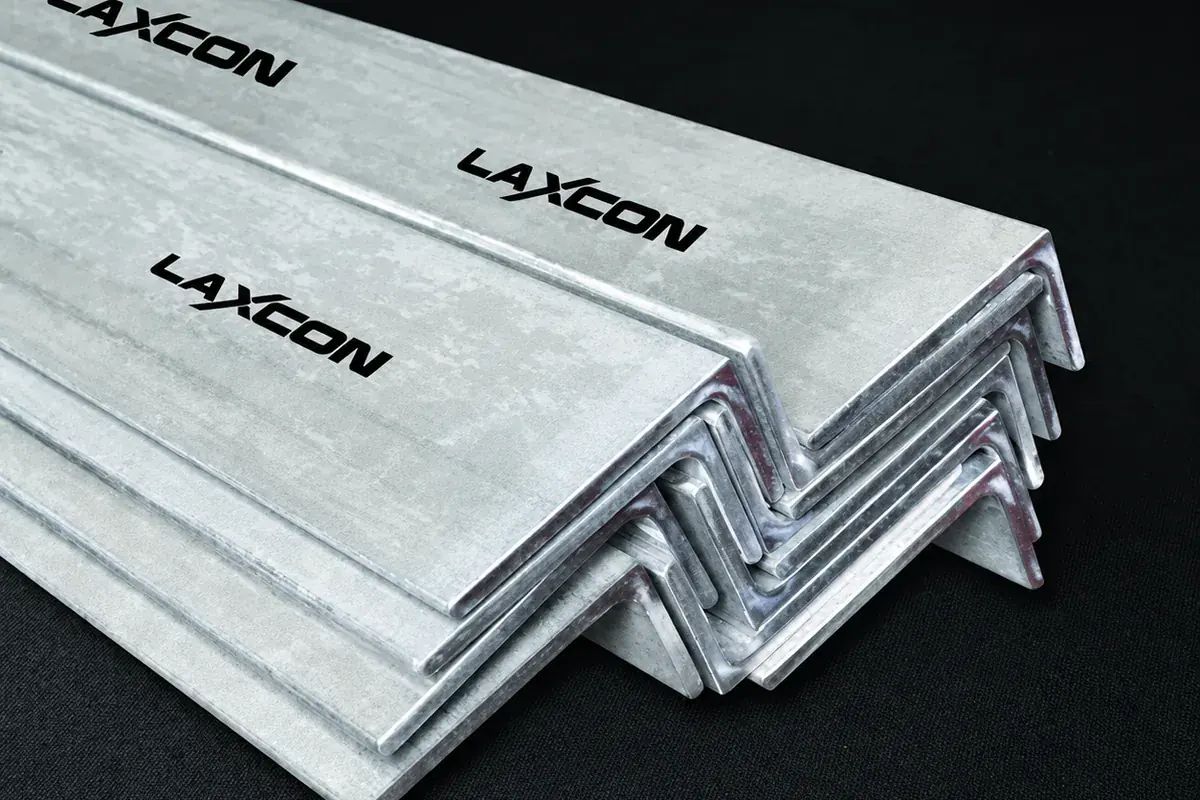
Angle Grades
Angle Reference
Governing standards
- EN 10088-3
- Stainless steels: technical delivery conditions for semi-finished products, bars, rods, wire, sections and bright products for general purposes. Composition, heat treatment condition and mechanical properties per grade.
- EN 10056-1 and 10056-2
- Structural steel equal and unequal leg angles: dimensions (part 1) and tolerances on shape and dimensions (part 2).
- ASTM A276/A276M
- Stainless steel bars and shapes: composition, condition, mechanical properties and finish designations for hot-finished and cold-finished bar.
- ASTM A484/A484M
- General requirements for stainless steel bars, billets and forgings: permissible variations in dimensions, straightness, weight and length, and the test and marking requirements every bar order inherits.
- EN 10204
- Metallic products, types of inspection documents: the 2.2 test report and the 3.1 and 3.2 inspection certificates a purchase order can call for.
Equal and unequal angles
An equal angle is specified by one leg length and one thickness, from 20 x 20 x 3 mm to 127 x 127 mm, and is the general-purpose stainless structural section: frames, brackets, supports, tank stiffeners and the corner protection on kitchen and process equipment. An unequal angle is ordered by long leg, short leg and thickness, 25 x 15 x 5 mm to 100 x 75 mm: the long leg takes the bending load or the bolt row, the short leg the flange or the seating. It weighs less than the equal angle of the same long leg and thickness, and it is the section used where a chassis rail, a stair stringer or a support bracket has room on one side only.
Both are hot rolled, annealed and pickled to EN 10056-2 or ASTM A484 tolerances and supplied with deburred or plain ends in lengths to 6.4 metres. Weight per metre at a density of 7.90 g/cm³ is (2A x t minus t²) x 0.0079 for an equal angle of leg A and thickness t, and (A + B minus t) x t x 0.0079 for an unequal angle of legs A and B. Root fillets and toe radii are not in the formula, so a rolled angle weighs 0.1 to 2.9 percent more than the figure it gives; the finish pages list the weight of every published section.
Uses and grades
Stainless steel angles are used in metal construction, industrial and agricultural applications: metal frames, brackets, steel chassis, and components and parts of machinery. Unequal angles are also used in the automotive industry and in construction where unequal support is needed. Composition limits for the grades rolled as angle are in the grade reference.
Frequently Asked Questions
What stainless steel angle sizes does Laxcon make?
Laxcon rolls HRAP stainless steel equal angles from 20 x 20 mm through 127 x 127 mm in thicknesses of 3 mm to 15 mm, and unequal angles from 25 x 15 mm through 100 x 75 mm in thicknesses of 3 mm to 10 mm.
Which standards and lengths apply to stainless steel angles?
Stainless steel equal and unequal angles are supplied up to 6.4 metres in hot-rolled, annealed and pickled condition to ASTM A484 and EN 10056 tolerances.
Which finishing and identification options are available?
Angle ends can be deburred or supplied plain without sharp edges. Grit polishing and shot blasting are available on request, with inkjet marking and PMI grade confirmation.
How can stainless steel angles be packed and traced?
Laxcon packs stainless steel angles in standard bundles of 500 to 1,000 kg with HDPE or LDPE wrapping and two lifting slings. ISPM 15 wooden boxes and fibre-tube packing are available, and every bundle is marked with heat number, grade, size, and net and gross weight.
What is the weight of a 50 x 50 x 5 mm stainless steel angle per metre?
A 50 × 50 × 5 mm stainless steel angle weighs 3.75 kg per metre at 7.90 g/cm³, so one tonne holds about 267 metres. A 40 × 40 × 6 mm angle weighs 3.51 kg and a 75 × 75 × 6 mm angle 6.83 kg per metre.
What is the price of stainless steel angles per kg?
Stainless steel angle is priced per kilogram, and the price depends on the grade, the size, the finish, the length and the quantity ordered. Laxcon Steels quotes each order on request.
Are stainless steel angles available in 904L, 2205 or 316Ti?
No. Laxcon does not offer angles in 904L, duplex 2205 or 316Ti. Both angle forms are rolled to order in the other grades of the grade list above, including super duplex 2507 and lean duplex 2304.
Which is cheaper, 304 or 316 stainless steel angle?
316 contains 2.0 to 3.0 percent molybdenum and more nickel than 304, which raises its resistance to chloride pitting and also its price. 304 vs 316 stainless steel compares the two grades in full.
More questions
When is an unequal angle used instead of an equal angle?
An unequal angle is used where the two legs carry different loads or where one leg must clear an obstruction. It weighs less than the equal angle of the same long leg and thickness.
What are the most common stainless steel angle sizes?
Equal angles are rolled in 17 leg sizes from 20 × 20 mm to 127 × 127 mm, and unequal angles in 18 profiles from 25 × 15 mm to 100 × 75 mm; the equal angle and unequal angle pages give the thicknesses for each.
How does Laxcon make stainless steel angles?
Laxcon melts stainless scrap in its own steel melting shop and casts it on a twin-strand continuous caster. The steel is hot rolled on the company’s cross-country mills, then solution annealed and pickled. The mills and furnaces are listed on the technology page.
What are stainless steel angles used for?
Stainless steel angles are used for frames, brackets, supports and tank stiffeners, the corner protection on kitchen and process equipment, steel chassis and parts of machinery. They serve in metal construction and in industrial and agricultural applications.
What is the difference between a stainless steel angle and a mild steel angle?
Stainless steel contains at least 10.5 percent chromium, which forms a self-healing oxide film that resists rust, while mild steel rusts without a protective coating. Mild steel vs stainless steel sets out the other differences.
Does a stainless steel angle rust?
A stainless steel angle resists rust because its chromium forms a thin oxide film that repairs itself, and it can rust where chlorides, embedded iron or weld heat tint break that film. Does stainless steel rust explains the conditions.