The Hardest Metals on Earth, and How the Hardness of a Metal Is Measured
Send an enquiryThe hardest pure metal is chromium, which scores 8.5 on the Mohs scale of scratch hardness, followed by tungsten at 7.5 and osmium at 7. Tungsten carbide, often named as the hardest metal, is not a metal but a ceramic compound of tungsten and carbon, and diamond, the reference point of the Mohs scale at 10, is not a metal at all. Among the materials actually made into parts, hardened tool steel and hardened martensitic stainless steel reach 60 to 67 on the Rockwell C scale, which is harder than any pure metal in its natural state. Hardness is the resistance of a surface to indentation or scratching, it is measured on several scales that do not convert into one another exactly, and it is a different property from strength and from toughness, which is why the hardest metals are rarely the ones used to carry a load.
The hardest metals, ranked
The ranking below uses the Mohs scale because it is the only scale on which every metal has a published value. The Vickers and Brinell columns are given where a figure is published for the pure metal in its annealed state; they vary widely with purity and condition, and for chromium in particular the published range runs across an order of magnitude, so they are a guide to the order and not a specification.
| Metal | Mohs | Vickers, HV (approximate) | Brinell, HB (approximate) | Note |
|---|---|---|---|---|
| Chromium | 8.5 | 110 annealed; to 1,000 as a hard plating | 70 to 660 | brittle in bulk; used as an alloying element and as hard chrome plating |
| Tungsten | 7.5 | 350 to 470 | 200 to 400 | highest melting point of any metal; ductile only when worked hot |
| Osmium | 7 | not reliably published | about 400 | densest element; brittle, unworkable |
| Iridium | 6.5 | 180 to 225 | about 170 | brittle; used in spark plug tips and crucibles |
| Titanium | 6 | 85 to 350 | 70 to 280 | commercially pure; alloys harder |
| Cobalt | 5 | about 105 | about 70 | the binder in cemented carbide |
| Iron | 4 | about 60 | about 80 | pure iron is soft; steel is iron made hard by carbon |
| Nickel | 4 | about 65 | about 70 | soft pure; hard in aged superalloys |
The engineering materials that matter more in practice are alloys, and they are ranked on the indentation scales rather than on Mohs. Hardened and tempered tool steel (D2, M2, the high speed steels) is 60 to 67 HRC, about 700 to 900 HV. Hardened martensitic stainless steel reaches 50 to 55 HRC in grade 420 and 58 to 60 HRC in the higher-carbon 440C. The precipitation hardening grade 17-4 PH reaches 40 to 44 HRC in its H900 condition. Nickel superalloys such as Inconel 718 are 36 to 45 HRC after ageing. Cemented tungsten carbide, the material of cutting tool tips, is 1,300 to 1,800 HV, and pure tungsten carbide about 2,200 to 2,600 HV. Annealed austenitic stainless steel, the 304 of kitchen equipment and bar stock, is about 150 to 200 HV, or 80 to 90 on the Rockwell B scale, and is soft by any of these measures.
Hardness, strength and toughness
Hardness is the resistance of a surface to being indented or scratched. Strength is the stress at which a material yields or breaks in tension. Toughness is the energy a material absorbs before it fractures. The three are related but not the same, and the hardest materials are usually the least tough: glass scratches steel and shatters when dropped; cemented carbide holds an edge and snaps under a bending load; osmium and iridium are hard and cannot be worked at all. For steel, hardness and tensile strength track each other closely enough that one is used to estimate the other: tensile strength in MPa is roughly 3.4 times the Brinell number, so a steel of 300 HB has a tensile strength of about 1,000 MPa. Toughness moves the other way, which is why a hardened steel is tempered, trading a few points of hardness for the ability to survive an impact. The strongest metals are ranked on tensile strength and the list is different from the one above.
The hardness scales
Every hardness test presses a defined indenter into the surface under a defined load and measures the size or the depth of the impression. The scales differ in indenter, load and what is measured.
The Mohs scale, from 1812, ranks ten reference minerals from talc at 1 to diamond at 10 by which scratches which. It is ordinal: the interval between 9 and 10 is many times the interval between 1 and 2. It ranks minerals and pure elements, never a steel specification.
The Brinell test (ISO 6506, ASTM E10) presses a 10 mm tungsten carbide ball into the surface under 3,000 kgf for 10 to 15 seconds and measures the diameter of the impression; the hardness number HBW is the load divided by the curved area of the impression. It averages over a large area, which suits castings, forgings and annealed bar, and it reaches about 650 HBW before the ball itself deforms.
The Rockwell test (ISO 6508, ASTM E18) measures the depth of penetration under a major load after a minor load has seated the indenter, and reads the number directly from the machine. The C scale uses a diamond cone under 150 kgf and covers hardened steel from about 20 to 70 HRC. The B scale uses a 1.588 mm ball under 100 kgf and covers soft steels, annealed stainless steel and non-ferrous metals up to 100 HRB, above which the C scale takes over. Rockwell is the routine test on a shop floor because it needs no measurement of the impression.
The Vickers test (ISO 6507, ASTM E92 and E384) presses a diamond pyramid with an angle of 136 degrees between opposite faces under a load from a few grams to 120 kgf and measures the diagonals of the square impression. Because the impression is geometrically similar at every load, one continuous scale runs from the softest metals to the hardest ceramics, and at low loads the test measures individual phases, case depths and coatings. The Knoop test uses an elongated pyramid for thin layers.
Hardness conversion chart for steel
The scales are related empirically, not by formula, and ASTM E140 tabulates the relationships for steel from tests on many heats. The table below gives the Rockwell C, Vickers and Brinell equivalents for non-austenitic steel with the approximate tensile strength each corresponds to. The conversion holds for carbon, alloy and martensitic stainless steels; austenitic stainless steel and non-ferrous metals have their own tables, and a conversion applied across families is a guess. Brinell numbers above about 650 HBW lie beyond what the tungsten carbide ball can measure, so at the top of the table the Brinell column is a tabulated equivalent rather than a figure a Brinell machine would return, and is marked as such.
| Rockwell C, HRC | Vickers, HV | Brinell, HBW 10/3000 | Approximate tensile strength, MPa |
|---|---|---|---|
| 65 | 832 | 739 (beyond the Brinell range) | not tabulated |
| 60 | 697 | 654 (at the limit of the test) | not tabulated |
| 55 | 595 | 560 | 2,050 |
| 50 | 513 | 481 | 1,760 |
| 45 | 446 | 421 | 1,480 |
| 40 | 392 | 371 | 1,250 |
| 35 | 345 | 327 | 1,100 |
| 30 | 302 | 286 | 965 |
| 25 | 266 | 253 | 850 |
| 20 | 238 | 226 | 770 |
Below 20 HRC the Rockwell B scale is used: 100 HRB is about 240 HV and 240 HBW, 90 HRB about 185 HV, 80 HRB about 150 HV and 70 HRB about 125 HV.
How hardened steel reaches 60 HRC
Pure iron is a soft metal at about 60 HV. Steel becomes hard by carbon and by heat treatment. When a steel with 0.6 to 1.0 percent carbon is heated above about 800 degrees Celsius and quenched, the carbon is trapped in a distorted crystal structure called martensite, and the hardness rises to 60 to 65 HRC; tempering then brings it down to the 55 to 60 HRC at which a tool holds an edge without chipping. The martensitic stainless grades 410, 420 and 431 harden the same way, to 40, 50 and 45 HRC respectively. The austenitic grades cannot: 304 and 316 have no transformation to martensite on quenching, and their hardness rises only by cold work, from about 85 HRB annealed to 30 HRC or more after heavy drawing, which is why a cold drawn bright bar is measurably harder than the hot rolled bar it was made from. The precipitation hardening grades harden by a third route, a low-temperature ageing treatment that precipitates a fine copper-rich phase, taking 17-4 PH from 33 HRC as supplied to 44 HRC at H900, as set out in the heat treatment article.
Hardness on the certificate
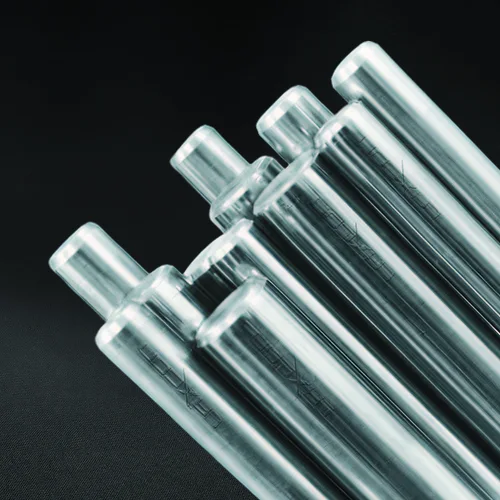
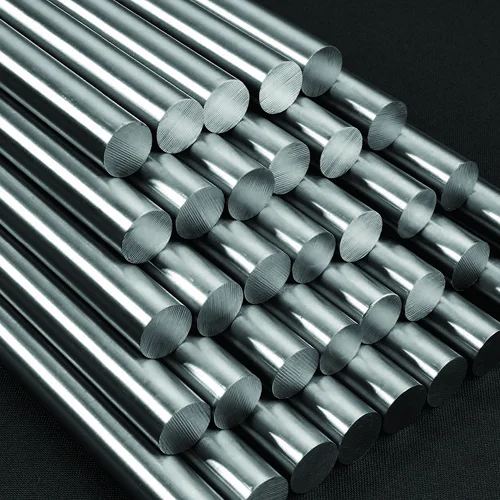
Laxcon Steels rolls the martensitic and precipitation hardening stainless grades above as precipitation hardening bar, hot rolled round bar and bright bar from 5 to 115 mm, and its laboratory tests hardness on the Brinell, Rockwell and Vickers scales; the value and the scale are reported on the mill test certificate beside the tensile results, in the condition the bar was delivered in.
Frequently asked questions
What is the hardest metal on earth?
Chromium is the hardest pure metal, at 8.5 on the Mohs scale, followed by tungsten at 7.5. Tungsten carbide, which is harder than both, is a ceramic compound rather than a metal. Among usable engineering materials, hardened tool steel at 60 to 67 HRC is harder than any pure metal.
Is tungsten harder than steel?
Pure tungsten, at 350 to 470 HV, is harder than annealed steel but softer than hardened steel, which reaches 700 to 900 HV. Tungsten is valued for its melting point and its density rather than its hardness; the hard tungsten material in cutting tools is tungsten carbide bonded with cobalt.
What is the difference between hardness and strength?
Hardness is a surface's resistance to indentation or scratching; strength is the stress at which the whole section yields or breaks. For steel the two rise together, and tensile strength in MPa is roughly 3.4 times the Brinell hardness, but toughness falls as hardness rises, so a part is hardened only as far as its service allows.
How do HRC, HV and HB convert?
Through the empirical tables of ASTM E140, valid for one family of steel at a time. For non-austenitic steel, 30 HRC is about 302 HV and 286 HBW, 40 HRC about 392 HV and 371 HBW, and 55 HRC about 595 HV and 560 HBW. Above about 650 HBW the Brinell test runs out of range, and harder steels are compared on the Rockwell C and Vickers scales instead. Austenitic stainless steel and non-ferrous metals need their own tables.
Sources
- ASTM E140, Standard Hardness Conversion Tables for Metals.
- ISO 6506, ISO 6507 and ISO 6508, Metallic materials, Brinell, Vickers and Rockwell hardness tests; ASTM E10, E18, E92 and E384.
- ASM Handbook, Volume 8, Mechanical Testing and Evaluation; Volume 2, Properties and Selection: Nonferrous Alloys and Special-Purpose Materials.
- ASTM A276/A276M and ASTM A564/A564M, the bar standards that state hardness limits for the martensitic and precipitation hardening grades.
- The grade properties in the Laxcon grade reference.